Meditation

Every fair from fair sometime declines.

This is my favorite sentence of all time. It is from Shakespeare’s Sonnet 18, and for me it encapsulates the bitter truth of life: entropy rules over all. Nothing gold can stay.[1]

Every fair from fair sometime declines.

The phrase kept coming to me as I worked to prepare the labyrinth for the Tour of Homes. Because of the nature of the Tour—everything is supposed to be pretty—I was reseeding the labyrinth with a “contractor’s blend” of grass, i.e., a mixture of regular fescue seed and winter rye, which grows quickly and provides you with a vividly green carpet at any time of the year.

Rye is extremely temporary. It grows and, after a month or two, dies. That’s fine. I only needed the labyrinth to look “pretty” for Dec 3. After that, nature could resume its cycle.

Because normally I do not try to maintain a green labyrinth through the winter months. It is pretty, but part of having this meditative space is learning to see the beauty in all phases of its life. Bare branches, brown ferns, dead grass—all are part of the way life goes. It is best if you can love that.

[slideshow_deploy id=’5940′]


Yes, the tired old metaphors of our human lives winding down apply. Shakespeare as usual says it best, this time in Sonnet 73:

That time of year thou mayst in me behold
When yellow leaves, or none, or few do hang
Upon those boughs which shake against the cold…

Part of our sadness about the entropy of our lives is our consciousness that while nature’s course will cycle back around—the leaves will grow again, the ferns will push up through the humus, the grass will sprout as green as before—with us the decline is permanent. We don’t get to be young again. We won’t, as the sun shifts back to the north, find ourselves regaining our muscle tone or youthful skin or mental acuity.

This of course is our ego’s perception. It is not reality. The leaf falls from the tree, but the tree is still alive. So it is with us. “We” may die, but the universe is still alive. Thinking that somehow our ego will continue to exist after our death is essentially planting rye grass: shoring up a false hope that will not, can not last.

Every fair from fair sometime declines: words to live by.

—————

[1] This is why, in my setting of Sonnet 18 for men’s chorus and two cellos, that line is the musical climax.

Not so easy question, The Wall edition

I for one am not even astonished that the Congress is looking to fund the president-elect’s “wall.”  So what if the man said that “Mexico will pay for it”?  Apparently nothing he said on the campaign trail matters.[1]

It also doesn’t seem to matter that the party of “fiscal responsibility” and “small government” now wants to jumpstart the biggest boondoggle since the Iraq war.

But I do have some questions for my elected representatives.

  • Does the congressman have data (in the form of research studies or reports) on the effectiveness of a “wall” in keeping migrant workers from entering the country from Mexico?  Can you provide me with a link to any of those?
  • Does the congressman have data (in the form of research studies or reports) on the impact on employment/wages in this country if low-wage migrant workers are excluded from the economy?  What are his plans to prevent wage inflation if the country loses access to these workers?
  • Has the congressman weighed the opportunity costs between building the “wall” and investing in the country’s infrastructure?  In other words, given our limited resources, is it going to be a better strategy to insure our economic future to build the wall rather than to repair our bridges, roads, and airports?

Or, bluntly, is the congressman’s vote based purely on the symbolic vindictiveness that seems to characterize his party?

—————

[1] It doesn’t matter because the only thing that matters to the Republicker party is that they now have a patsy in the White House.

Another new day

You may recall that one of my goals this year was to establish a daily work schedule so that I have more structure to force myself into working.

There was no point in trying to do this until this week because reasons, but now I’m on day three of said schedule and I believe it’s working.

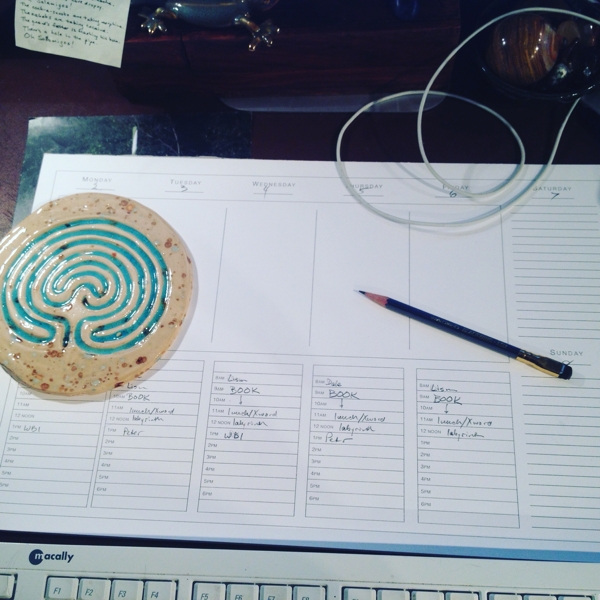
Step one: clear the desk — again — so that a) I have a clear view of my desktop calendar; and b) I have an actual work surface for one of my major projects.

What desktop calendar is that, you ask?  This desktop calendar:

Here it is in situ:

You may be astonished that I am using a paper and pencil scheduling device, but I can explain.  This is the desktop calendar I used to use at Newnan Crossing and at the Department of Education to do my planning, and it was very efficient.  Yes, I still put things on my phone or my computer, but this was a handy way to jot down meetings, phone calls, etc.  Mostly it kept me on track.

I used to buy these in pads from Levenger, but they stopped making them, and so I designed my own, if by “design” you mean “recreate exactly.”  I still have a couple in storage, and truly I don’t know why I had this one on my desk here in the study, since I don’t really have a lot to schedule these days.

Until now.  Like all good ABORTIVE ATTEMPTS, it’s a start.  I have created out of nothing a list of things that I want/need to get done, and I’ve faked a schedule: blog here and at Lichtenbergianism.com; work on Lichtenbergianism: procrastination as a creative strategy; eat lunch and do the crossword puzzle; walk the labyrinth; plan for [redacted] and William Blake’s Inn.[1]

That schedule will change, of course, but so far it’s driven me to work without too much procrastination.  I’m writing this blog post, in fact, because the schedule says I must.  Running a little late, but I can whack this out and then get back to work on the chapter on SUCCESSIVE APPROXIMATION.

With assistance[2,] of course.

—————

[1] No, there’s not a production in the offing.  I’m just working on it.

[2] For differing values of “assistance.”

Evil

I have been reading Mirrors, by Eduardo Galeano.  I have come to believe that there is a thread of evil running through human history that will not die but must be fought against without stint or let.

In the middle of a series of disquisitions about slavery and its never-ending end in the 18th and 19th centuries, I came across this:

When Iqbal Maiz was four, his parents sold him for fifteen dollars.

He was bought by a rug maker.  He worked chained to the loom fourteen hours a day. At the age of ten, Iqbal was a hunchback with the lungs of an old man.

Then he escaped and became the spokesman for Pakistan’s child slaves.

In 1995, when he was twelve years old, a fatal bullet knocked him from his bicycle.
[pp. 190-191]

In 1995.

Evil.

Evil is not having sex with someone to whom you are not married or is the same gender as you.  Evil is not realizing your brain is not the same gender as your body.  Evil is not praying to some other deity than you and your neighbors.

Evil is cruelty to anyone with less power than you.

Period.

Not in my name, not in my country.  Speak up.

Holy crap.

I don’t even really know how to phrase this in the form of a question.

The president-elect tweeted this morning:

“Happy New Year to all, including to my many enemies and those who have fought me and lost so badly they just don’t know what to do. Love!”

What are your thoughts about this man’s message?  Do you think this is appropriate for our nation’s leader?  Do you support this attitude?

Given that I have not had an answer to most of my easy questions, I don’t expect to hear from either of my senators on this one either.  (Still waiting for my new representative to emerge from his pod.)

A brief and frightening book

Recently fellow Lichtenbergian Daniel gave me a copy of George Saunders’ The Brief and Frightening Reign of Phil.

Do not even read the rest of this.  Go buy a copy now.

It’s only 130 pages long, and the pages are small, but you will not be able to read it in one setting.  It will gut-punch you over and over, with the the beauty of its writing and the horror of its prescience.  You will have to stop to let your soul absorb the shock.

It was published in 2005, but it could easily have been published on Nov 9, 2016.  The rapid and easy rise of the evil, hate-driven megalomaniac Phil gives you a sickening jolt of familiarity, even as Saunders’ loopy and surreal subworld creation leaves your brain  scrambling to reconfigure its comprehension of what it’s seeing.  Trust me, it’s weird and wonderful.

The premise is simple: in the midst of  the country of Outer Horner, there exists the country of Inner Horner, a country so small that only one of its citizens can live in it at a time.  The other six citizens have to huddle in the Short-Term Residency Zone right outside, surrounded by the unfriendly Outer Horner.  Spurred by an unrequited love of Inner Hornerite Carol, the odious Phil jacks up his fellow Outer Hornerians to suspect, tax, and eventually disassemble the hapless minority.

And then Phil’s brain slips out of its rack.

Trust me.  You want to read this.  (There is a website, of course.)

Another easy question

The precedent-elect [sic] has been tweeting again, so again I turn to my elected officials to see if they agree with him.

The president-elect has tweeted that the U.S. must “greatly strengthen and expand its nuclear capability until such time as the world comes to its senses regarding nukes.”

Do you agree that our nation should spend its resources on re-triggering the nuclear arms race?

Easy answer, one might think

So Newt Gingrich, who started our nation’s slide into hyperpartisanship and truthiness, was interviewed on NPR on Monday, and essentially he put it out there for normalization: the president-elect is so rich, so incredibly rich, such an unbelievably successful businessman, that we should not expect him to have to follow our federal ethics laws.

::sigh::

Off to the representatives we go:

On Monday, Newt Gingrich said that the president-elect can’t be expected to follow current ethics rules.

Do you agree that the president-elect should be allowed to ignore federal ethics rules?

And again we wait.