Sir Christémas: so far, so good

I had pulled together several texts last night which I found on The Hymns and Carols of Christmas, a pretty exhaustive site.

If you’d like to second guess me (other than the hundreds I didn’t even look at), here’s a list:

I really liked the Yule Days one, a kind of out-of-left-field version of “Twelve Days of Christmas.” (Thank you, Scotland.) But the accompaniment for this year’s competition is, as I mentioned yesterday, a celesta, very dainty and very quiet. I’ll set “Yule Days” for a more raucous accompaniment.

So which one did I pick? “Sir Christmas,” which is a little odd, since I think the text also suggests a more raucous setting. I know that we did one at Newnan Presbyterian that was a whole lot of fun and very hard on the choir and organist both.

Still, I’ve made a good start. I began by opening “Ginny’s Valentine,” a piece I did for Ginny one year when I forgot to do anything else, and assigning the celesta to it. Limited range, the celesta, especially in the Garritan Personal Orchestra version. I guess they only did the four-octave instrument, because it doesn’t have the range indicated by Anatomy of the Orchestra. The SoftSynth version, of course, has no range limits at all, since it’s synthesized and not sampled like the GPO. Also, if you will recall, SoftSynth has choral sounds while GPO does not, although the new Finale, arriving next week, is supposed to include new GPO choral sounds.

After I played around with getting a feel for the instrument, I opened up a new piece and just began playing with notes.

And here’s the first six measures for you to listen to. Just playing, and a long way to go with a non-metrical text, especially in a week and a half, but a good start.

Some random thoughts

My plan is to begin working on music in a fairly serious manner tomorrow night; it will be the start of my fall push. You may remember how I have realized that I work better with a schedule, so I’m devoting Sunday mornings and Tuesday and Wednesday nights to composing.

What will I be working on? I got email today reminding me that the deadline for the Welcome Christmas Carol Competition is next Friday, so I think I’ll see if I can knock something out for that. I should do some work on A Day in the Moonlight, but Mike’s in Africa for a while, so it’s not as if he can check up on me.

The challenge this year is to set a carol for SATB chorus and a five-octave celesta, which apparently is a big deal. (Del Mar’s Anatomy of the Orchestra says that four octaves is in fact the norm.) This is the instrument that plays (and indeed was first heard) in “Dance of the Sugar-Plum Fairy” from Nutcracker. It’s a very quiet instrument, played like a piano, unable to be heard above much of a mezzopiano.

Again, as I mentioned I think in May, finding the text is the hard thing. Maybe after I finish musing this post.

Last week, Diane Mize, my painting instructor from GHP so long ago (we have a mutual pact not to mention that number of years ever again), sent me an email from one of her favorite creative bloggers, Robert Genn, a painter. Like me, he recognizes that there are particular times of the day when he’s most apt to work spontaneously, but recently he came across an idea he shared in his biweekly letter (explained and subscribable here.)

The idea is to perform one more creative act before turning out the lights. Tiredness contributes in a way one does not expect. Casualness and the feeling of “something extra” make their mark. A lackadaisical twenty-minute afterthought becomes a creative bonus.

He talks about it being a way to use up extra paint, in his case. I’m wondering how I might do this. My creative times are in the evening anyway. I work best when I have specific times set aside, and I usually quit precisely at 9:00 unless I’m really burning through material. So an hour later, would there be “something extra,” or would it be just thoughts based on what I’ve already done? Again, I’d benefit more if I were able to jot down things I heard in my head in any kind of accurate way.

Genn makes it sound as if one is to return to one’s workspace, but “before turning out the lights” implies bedtime to me, especially since I work nearly up until that time anyway. Perhaps I could have some kind of bed-journal. This keeps sounding like yet another Moleskine notebook. Ah, well, if I must…

Yesterday, we went to the High Museum to see the Annie Leibovitz exhibit. It’s easy to be overwhelmed by an exhibit like this, not just through the sheer volume of great stuff that you have to assimilate before your legs give out, but also of the sheer greatness of the mind you are encountering.

Leibovitz was an enormous force in photography. Her celebrity portraits were witty without being gimmicky, and were often sumptuous. Her photodocumentary works were stark and powerful. Her “informal” photos, of family and such, were as carefully selected as her other work.

Much of her work stays with you, indeed, much of the exhibit one would have seen before when it was first published, but the portrait of Daniel Day Lewis especially intrigued me. Having such a handsome subject always helps, I’m sure, but I keep remembering the richness of his attire, the layers, the vest, the shirt, possibly a scarf or cravat, the greatcoat, all dark-colored and tumbling about him. He sat in near profile to us, his legs crossed elegantly away from us, and looking out from the dark background. It was somewhere between a dark Renaissance portrait and a Regency rake.

Of course, it is very hard not to regard the output of such a great mind as this as a rebuke, or at the very least, a challenge in several ways.

First, it seems to challenge you to respond to the art, to the mind; to know, to appreciate, to understand what the artist has accomplished and to embrace it, not only the polished result of a lifetime of seeing and doing, but the struggle of that seeing and doing in the result you see before you.

After looking at Daniel Day Lewis for some time, do I know him better? Of course not; that’s a fallacy of Vanity Fair readers everywhere. But I do know Annie Leibovitz better. I see her ability to see Lewis in terms that will reveal him to the viewers of this portrait. Despite her claim elsewhere in the exhibit not to be able to produce decent work in a studio, the Lewis portrait is a masterwork of sensuality and chiaoscuro.

This great work is of course a challenge to one’s own meagre doodlings. It’s a challenge to produce, to meet Leibovitz on her own terms, to explore and push your boundaries as she pushed hers, failure is not an option, even it it seems clear that it really is the only option. You want to play as well as she has.

::sigh::

Jesus Trucks

Yes, I know it looks as if I’ve abandoned the blog. But I haven’t done anything for the last two weeks because the air conditioner in my attic study was broken and I couldn’t work on anything major. A laptop actually on one’s lap in the living room is not quite conducive to extended bouts of creativity. Anyway, I should be back on schedule this week, and then, my faithful readers, you’ll have something to read.

In the meantime, there’s this purely American phenomenon to distract you. Yesterday, my family and I were out shopping, and in the parking lot of Target was a jeep-like vehicle. From its tow thingie were dangling two very large and very red bulbous shapes.

What is that, my lovely and sometimes naive wife wondered.

Grayson and I clued her in: it’s a scrotum. Testicles. Balls.

Ew, she said.

Maybe if I had an iPhone I would remember that I am equipped to snap a photograph on the spot, but since I bought my phone to be just a phone until I get an iPhone next year, I keep forgetting that I can whip that sucker out and document the atrocities. So there’s no picture of this marvel. However, I feel sure my faithful readers will have no problem at all envisioning this. (And if you’re a liar and say you can’t quite see it, look here.)

But that was not enough. Above this dude’s testicular display, on the rear window, was a very large decal: Calvin, kneeling in prayer before the cross, with the statement, “Every knee shall bow,” in Old English text, of course.

Well.

Is it just me, or is there a disjunct between those two cultural signifiers?

Let me rephrase that: Shouldn’t there be a disjunct between those two cultural signifiers? Because, unfortunately, there’s not.

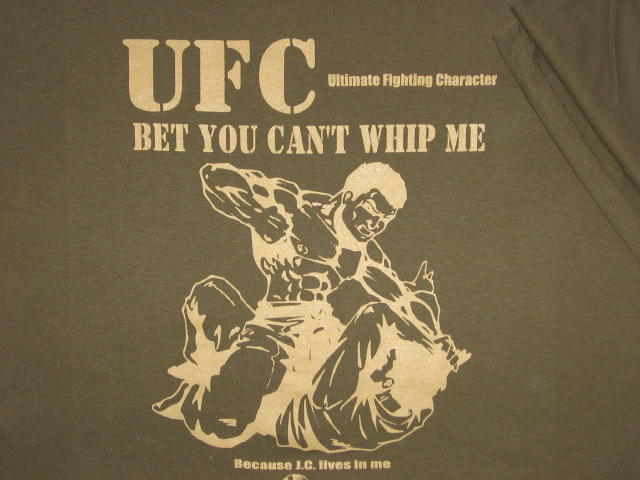
Observe:

Or this:

This is from a t-shirt sold by Operation Straight Up Tour, a group officially promoted by the Pentagon; it is an “evangelical entertainment troupe that actively proselytizes among active-duty members of the US military.” (quote from Max Blumenthal, writing in The Nation)

Shall we take care of the snickering first? Such is my readership that I think I don’t have to point out the Tom of Finland [NSFW] allusions in this Straight Up (what were they thinking?) merchandise. Is it possible, how is it possible, that our young men in uniform can look at this shirt and think, “Wow! That’s tough!” and not “I don’t know, Sarge, that looks a little homoerotic to me…”? [If I were very evil, I could continue with: Sarge says, “Hm. Take off your shirt and sit on my face and let’s see.”]

Enough of that. No, I said, enough of that. Back to our main point, which is that if I learned anything in Sunday School at First Baptist, it was that the main idea of the Christ’s teachings was that we didn’t beat up the other guys. Moreover, if they offered to whip us, we should let them. No, really, that’s what he said. Not a lot of wiggle room there.

So who are these people with Jesus Trucks and queer bodybuilders and badass attitudes? Besides Republican voters, I mean. Really, if one owns a t-shirt that says “Because J.C. lives in me,” should one be threatening the rest of the populace with violence? Or imprecatory prayer?

Is this testosterone-addled abomination now what Christianity has become?

Harry Potter and the Middle Kingdom

Those of you who were as curious as I about the Chinese versions of Harry Potter running unconstrained throughout the continent, rejoice! Apparently the editorial board of the NYT were as curious, and unlike you and I, they have the resources to summon up summaries and excerpts from the works mentioned in the original article.

Accio, sequels!

Snark

Well. Sometimes I think that public figures just have better script writers than we do, you know?

I don’t think my personal sitcom could ever reach these heights: Florida state representative Bob Allen (D/R?-no really, guess which party) chairs the Florida House Energy Committee and co-chairs John McCain’s campaign in Florida. He is the Police Union’s 2007 Lawmaker of the Year, and he of course, of course!, sponsored six different sex crime bills this year alone, with three focusing on indecent exposure and soliciting sex, and one in particular to “crack down on soliciting sex in public parks.”

We will now pause a moment for everyone to guess what Rep. Allen was arrested for last month in Titusville.

If you guessed “offering oral sex to an undercover agent in a public restroom,” you are clearly ready for a career either in Los Angeles or Washington, DC, if not in Tallahassee.

As you know, I am not easily shocked, but I am easily amused. Rep. Allen is now a personal hero of mine, not because he declined to pay $20 for a blowjob and then offered to do the other guy for free instead, but rather because of his explanation. He had taken shelter in the public toilet, he says, because it was raining, and it seemed to him to be safer to stay in the john than to, I don’t know, get in his car and drive home.

All yet might have been well, if only this guy hadn’t approached him. Wouldn’t you know it, the undercover agent (as it turned out) was, in Rep. Allen’s words, “a pretty stocky black guy, and there’s other black guys around in the park that, you know!” Rep. Allen’s nervousness reached new heights.

And so, in a fit of panic, one supposes, Rep. Allen offered to do the guy so he could get away from him. Clever move, Rep. Allen. Maybe a bit unclear on the concept of “evasive tactics,” but who among us can say what we would do if we were taking shelter in a public park’s men’s room late at night and were approached by some dude who to all appearances was a prostitute?

Okay, so most of us can say what we would do, and it wouldn’t be to offer the guy trade. My own personal response would be to murmur, “Why, how kind of you to think of me, but I must decline. Thank you anyway.” A polite smile and a small nod of the head, perhaps, and then a quiet, “Perhaps you will excuse me,” as I left to take my chances in the downpour. But that’s just me. Your mileage might vary.

It occurs to me, because I am of a wicked turn of mind, that at least we know now why he is the Police Union’s Lawmaker of the Year.

Day 365

Well, here we are. The end of the experiment. Was I able to be creative every single day for an entire year?

Short answer: of course not, if by creative we mean “producing something new.” Many was the day I had no time, nor the energy, nor the ideas even to commit failure to paper. I knew that going in, needless to say.

At one point in the year I know I expressed envy of those on the web who were doing similar kinds of projects, producing a drawing or watercolor or small oil or photograph every day. I don’t know that I would have overcome my reasons for not producing every day if I had been producing a concrete thing rather than music (my focus for the most part), but it seemed to me at the time that they had an advantage over me. (So why didn’t I just whip out a watercolor those days?)

Would I able to claim that I was creative every day if we don’t mean “producing something new”? Perhaps. As I read Out of Our Minds and skimmed back through some other books like Fearless Creating and Twyla Tharp’s Creative Habit, I was reminded of what I already knew going in, that creativity is not production. It is a process that must include plenty of incubation as well as consumption of material. However, I think I claimed those days.

Mostly what I have found is that I do best when I’m a) on a schedule; and b) on a deadline. If I set aside Sunday mornings and then two evenings a week to compose, then I actually do compose, or at least fail at it. And the days in between, I am thinking about the stuff I’m working on.

The schedule also means I have the time to get in the groove. It takes me about twenty minutes to warm up, so to speak, and to get ideas flowing out of my head. At least that’s the case with composing. Writing, I can do on the fly (witness my dog-walking lyrics) if I’ve set myself a framework. I can spew some music while walking, but it’s all guesswork, since I have not yet achieved my goal of being able to transcribe what’s in my head.

Having learned all of this, I think I’m able now to set up the conditions under which I will be most productive. I may be able to, in the future, modify those conditions, but for now, I know what works for me.

So what did I accomplish this year?

First and foremost, of course, was the completion of William Blake’s Inn. A project that has occupied me off and on for twenty-five years, I was on the last leg of the journey when I started this project: finishing Blake Leads a Walk on the Milky Way. It took me over a month to do that.

Next it was orchestrating the entire work. (I think I may have started orchestrating some of the pieces in order to distract from Milky Way.) This project is not quite finished, of course. I have not yet officially orchestrated The Man in the Marmalade Hat Arrives and Blake Tells the Tiger the Tale of the Tailor. They’re quasi-scored using various instrumental sounds in the piano score, but I don’t have actual orchestral scores for them yet. Unless someone in Newnan, GA, steps up to organize the production, my widget says we have 447 days until opening night, those two items will remain on the back burner.

At the same time, I started the “Highway 341” poem. I used that as a fallback item on days when I didn’t/couldn’t compose, but I haven’t worked on it since shortly before finishing Milky Way. I guess at that point the Inn took over. Well, it’s still a pretty good start, and I can return to it in the coming year. I would have to go back and do some deep thinking, of course, because I’ve gotten it to a point where I would actually have to start writing about the feelings that inspired it to begin with. And those were never very clear.

I also began, last August, noodling around on my symphony. Needless to say, I haven’t given that any thought since September either, but that is going to be my major project this fall and winter: Stephen Czarkowski has asked for it for next summer’s orchestra. Not exactly a commission, but hey, a request is as good as, right?

Also accomplished this year: Lacuna’s workshopping of the William Blake pieces. Very nice, lots of fun, and very very creative. I like working this way. I don’t like working without a permanent home: my van looked like one of those crazy people with all their prized possessions stacked inside. For months. But the give and take of the workshop sessions was invigorating. If the world premiere gets a green light, then I truly look forward to developing the entire scenario in this way.

I learned how to use CSS (Cascading Style Sheets) on websites, and that has been a very good thing.

I adumbrated and fleshed out the 100 Book Club at school. By the end of the year, we were up and running, but not at full speed. I’m looking forward to figuring out how to ramp that up this year. If it works, I will truly have something amazing to share with the educational community: a reading program that challenges our best readers to read thoughtfully and deeply and then to write about their experience.

I wrote The Invocation, which still stands up as valid. In a similar vein, we established the phase successive approximation as our mantra.

I began work on songs for A Day in the Moonlight, sketching out three so far. Once I get school started and am able to establish a schedule for myself, I could finish that by Christmas. Warning: I’m not orchestrating this baby. I’m just providing vocal/piano scores.

I rediscovered my Stars on Snow album of new age music and began to play with some of those files in Logic Express, Apple’s sound sequencer, which I began to learn how to use this summer.

I got inspired and wrote “Dance for double bass duo and marimba” which not only was greeted warmly by everyone concerned but which was premiered at the final GHP concert. I have a recording, but they were playing from the back of Whitehead Auditorium. I’m going to play around with it in Logic and see if I can beef it up a bit.

As a sidelight of “Dance” and the readthrough of Milky Way, I found myself suddenly in demand as a composer. Other than the Symphony, I have two requests for pieces. One of them is a serious request and I’ll work on it this fall. This is a very strange place for me to be in. I’m still sorting through that.

And I made a mug.

Something else got accomplished this year: a very small community of very smart readers helped me out. I’ve been checking out the posts, it’s taking me a very long time to write this, and I come across posts like this one. The post itself is very good, I think, but it’s the comments that blow me away: literate, thoughtful, witty. I like writing for you guys.

Next? I will finish the songs for Day in the Moonlight, and I will write my Symphony No. 1 in G major. That’s enough to be going on with. Of course, if a project coordinator materializes for William Blake’s Inn, then I’ll be back at work on that.

Will I keep blogging? I’m sure I will, although I may not blog every day. We’ll see. Don’t expect anything for a few days, anyway. My study is still unclean from GHP.

Checking back, I noticed that I started this project on August 1. Shouldn’t I have finished on July 31? How did I lose four days? Oh well. I knew that was bound to happen as well.


Day 364

One day to go, but before we get serious, a response to yesterday’s post on copyright and the flux of the Commons, from Jeffrey R. (for “Raline,” we think) Bishop: listen to this. Some of us have way too much time on our hands. As I said yesterday, I’m thrilled that the planet is mashing up William Blake’s Inn. However, if he starts getting rich off of it, I’m going to sue his ass off for an unauthorized derivative work.

Tonight, Kevin McInturff called to chat about a couple of things, but one thing he asked me in particular: do I think that having blogged about my 365 days of creativity has made me more creative?

Yes, I do, actually. It made me more conscious of wasting time, and even though there were plenty of days tagged “not” (39 to be precise, 11% of the year), usually those were days when real life simply left me no time to do any work. The days I actually goofed off were pretty few.

Though my audience was small, you guys were an audience. I was highly aware that you read what I wrote and followed my ups and downs, and that made me determined at least to write every day, whether I had accomplished anything or not. Kevin suggests that those days were often more interesting than the ones where I gloated about my triumphs.

Will I continue doing this? Let’s see tomorrow.

Further musings on copyright (Day 363/365)

It did not work out for me to produce original stuff today, but this article in the New York Times caught my eye. In it, the Chinese are having a riproaring good time with Harry Potter. J. K. Rowling’s subcreation is a huge hit even in the Middle Kingdom, and there, copyright doesn’t mean what it means here. Mostly, it means nothing.

Quick sidenote: today was the first day back to work at Newnan Crossing, and one of the boxes waiting for me was the box from Bound-to-Stay-Bound containing our two copies of Deathly Hallows. As I pulled the books from the box, I noticed an orange slip of paper in each. They were my warning notice to keep them secure and not to display them or show them to anybody before 12:01 am, July 21. In other words, if I had been there to open the box when it came in, I would have had copies of the final book before any of the rest of you. Behold the power of the librarians! Bwahahaha!

Anyway, copyright in China. In China, you can buy Rowling’s Harry Potter and the Deathly Hallows from their equivalent of Scott’s Bookstore or Barnes & Noble. You can also buy it on the street, photocopied and bound, for a lot less. But you can also buy Harry Potter and the Showdown, by Li Jingsheng, a textile factory manager who had bought the first six books to read to his son, and in response to his son’s wanting to know how it ended, wrote his own, 250,000 words worth.

Mr. Li made the mistake of posting his version on the intertubes, where it quickly logged 150,000 readers, and now you can buy it on the street. Not that Mr. Li is making money off it: Chinese pirates will rip off anyone, not just billionaire Scottish authoresses. (Mr. Li’s readers have begged him for book eight, which he has already begun, unlike the ungrateful Ms. Rowling.)

But you can also buy (and I’m getting to a point soon, I promise) Harry Potter and the Hiking Dragon, Harry Potter and the Chinese Empire, Harry Potter and the Young Heroes, Harry Potter and Leopard-Walk-Up-to-Dragon, and Harry Potter and the Big Funnel. I’m not too sure about that last one.

Rowling’s publishers have of course taken steps to quash all this, but I’m sure once you get over into the Qinghai province, you don’t have much of a presence as a Western litigator.

So here’s the deal: wow. A fifth of the world’s population is so taken with your creation that they have an entire black market economy based on it. Wow. They’re writing their own, melding it with their own culture. It cannot be suppressed, and their government’s pretty darn good at suppression.

Copyright, as we’ve said before, was put into place to protect a creator’s work for a limited time so that he/she can make money from its sale before it gets subsumed by the Commons. But it does get subsumed by the Commons, precisely so that the rest of us can use it to spur our own creations, be it Harry Potter and the Big Funnel or The Winter’s Tale (yes, I’m looking at you, Mark Helprin.)

Now, when Joanne Rowling was a starving artist with a wee bairn, then absolutely Bloomsbury and Scholastic should have guarded her interests with as much ferocity as the law allows. And yes, I know that legally nothing is different now that she’s the world’s first billionaire author. But you know what? It is different. Copyright was designed to allow her some space to get income off her creation if she could, and I think, by any standard, she’s done that. She can’t even give it all away in her lifetime, and it’s not as if the end of the series is the end of her income. She is, to put it mildly, filthy rich.

I also think she’s done more than amass an unimaginable fortune from her copyright: she has given the world a huge gift to their narrative pool. Enormous. Stupendous. Unequalled in the 20th/21st century, even. Harry Potter burst the bounds of normal copyright considerations years ago, look at all the fanfic online, the slash fiction, the YouTube parodies, and now an entire Chinese industry. A completely alien culture has taken her work and run with it, churning the narrative pool in what I think is a very exciting way. If I had made a fortune off of William Blake’s Inn, I’d be thrilled to see the entire planet riffing on my stuff. Shoot, even if I hadn’t made a fortune, I’d be thrilled.

So while I support the lawyers in their quest to shut down the fake Deathly Hallows sales or the books that purport to be actually by J. K. Rowling, that’s a direct violation of the ethos of copyright, I am not so supportive of any efforts to suppress the rest of it. If I were Rowling, I’d instruct my lawyers to go collect all of it. I’d want my personal copy of The Big Funnel. Translated, of course.

Stuff less bad? (Day 362/365)

So, I thought, what if I put the first part of the chorus (and all of the verses) in the minor, and then switch to major with the end part? This is what that sounds like (along with the inevitable ritard at the -ex rhyme.)

In other news, last night I watched The Five Obstructions. In it, two Danish filmmakers play. Jørgen Leth, the elder, agrees to remake portions of one of his first films, The Perfect Human, under amazingly restrictive obstructions set by the younger, Lars von Trier. For example, the first little movie must be made 1) with no edit longer than 12 frames (about half a second!); 2) in Cuba, where Leth has never been; 3) without building a set; and 4) answering the elliptical questions in the original narration (Why does he move that way? How does he move that way?)

The frame movie is a documentary of the two men as they move through this process, which takes a couple of years. I’m not sure what von Trier is up to, he seems awfully abusive in his intent, and Leth seems quite sanguine about it, but it’s a fascinating study in creativity. Leth is apparently incapable of making crap, which is von Trier’s stated goal. No matter what the obstruction, Leth turns in a gem. This seems to irritate von Trier, until he finally makes the fourth obstruction one so hideous that both men blanch: it must be a cartoon.

Needless to say, the cartoon that Leth turns in is a masterpiece. So the fifth obstruction is even nastier: von Trier will direct it, Leth will be credited as director. Leth also has to narrate it, reading a letter to von Trier from him that von Trier has written.

Finally von Trier gets his wish: it’s crap. The narrative letter is opaque in a way that only Marc can explain for us, but it’s essentially a nannie-nannie-boo-boo that von Trier has written to himself about his failure to bring Leth down. The visual accompaniment, made up of black and white shots of the two men culled from the footage, is pedestrian, and that’s being kind.

What’s fascinating about the whole venture is the way that Leth scribbles down all the instructions, the obstructions, furrows his brow, goes away very depressed, and then sets about remaking his 1967 movie, itself a perfect gem and included on the DVD, using the obstructions as tools. He expresses this directly after the first one: the 12-second edit was like “a gift.”

And von Trier recognizes his error right away. He switches from technical limitations to personal issues, but nothing slows Leth down. It’s a truism, but it’s fun to watch two geniuses confirm it: limits are a spur to creativity, not a hindrance. One of my most creative productions ever was the 1997 Midsummer Night’s Dream, when NCTC had $200 in our checking account. (It was one of those years when I relinquished the treasurer’s duties to someone else.) We could buy practically nothing, and so everything we did had to be made from what was on hand. It absolutely worked.

Of course, that was luck, having on hand materials that lent themselves to that particular creative solution. And I would certainly not want to tackle a fullscale William Blake’s Inn with no money, in fact, I am in the process of not doing that even as we breathe, but limitations are certainly one way to get yourself moving if you cannot decide how to “be creative” next.

Bad stuff (Day 361/365)

I whacked out a melody (and harmonized it) for the chorus of “I Would Never” this morning, but I don’t like it. It doesn’t sound like something that Groucho would sing. It’s OK as a melody qua melody, but it doesn’t match the lyrics in a way that I like. Oh, it’s perky enough, especially for those variant lines at the end. That part might stay. It’s the first part that needs work.

Oh, you want to hear it? I don’t know that I should expose myself as such a fraud so close to the end here.

Here you go: iwouldneverchorus.mp3 It starts with “I… would…” held on two fermata’d notes, and then launches into it.

Here are the lyrics:

I would never (he’d never)
I’d never (no never)
deride or disparage an ex:
I’m such a defender
of the delicate gender,
my feelings so tender
for all of the opposite sex.

For Carol was crazy and Lucy was gay,
And as for poor Karrie, well, what can I say?
For much as I’d love to have wrung all their necks,
I’d never, no never, disparage an ex.

4 days to go.