Summer Countdown: Day 35

Productive, that’s what I was.

I established a page on this blog as a repository for permanent material related to my piece for the Ayrshire Fiddle Orchestra, and posted the two sketches I had already created, Vibes and The Labyrinth in Snow.

Then I turned around and created two new fragmentary sketches: Resignation and Rondo Mobile.

Resignation is based on the hymn tune most commonly associated with “My Shepherd Will Supply My Need.” I’ve always loved Virgil Thomson’s choral arrangement of the hymn, and in casting about for something that would come close to Wallace Galbraith’s suggestion that I write “music with its roots in your part of the world,” I was reminded of it.

It’s a gorgeous melody, and all I really need to do is voice it. But I’m going to try to gild the lily by taking it into interesting variations and harmonies. We’ll see.

The Rondo Mobile came about as I tried to come up with something that was close to the AFO’s “house style,” which is largely traditional Scottish/Celtic folk/dance music: stolid harmonies, “fiddly” arpeggiations, etc. I didn’t want to write a dance, but something more “arty” that used skills they already had. A rondo, of course, is a piece with a theme that repeatedly returns after contrasting themes, ABACADA, etc. Mine has a perpetuum mobile ‘A’ theme, and my plan is to send it off the rails, further and further each time, before returning to its simple-minded patter.

I want to do one more sketch before turning them over to Wallace for evaluation. What does everyone think about trying to arrange the third movement, the Allegro gracioso of the Symphony in G? I’d probably have to include a piano with this one to fill in some of the non-string textures, and it would be better if we could have a bass drum and tympani on the side.

Oh, and I also squeezed out two or three more drawings.
Art & Fear: 5

More thoughts on the idea that each choice you make , each brushtroke, each sentence, each musical phrase , limits your final product.

Of course it’s true in the simplest sense. If I start with a big slap of red paint in the middle of the paper, I know that I’m never getting rid of it. Red just doesn’t go away. If I start with a musical idea, that idea already has determined whether I can write a sonata or a fugue.

(When Shostakovich was a student, he was assigned a fugue statement as an exercise. He worked all night on the counterpoint but could only cobble together something he knew was “wrong” in the academic sense. When he turned it in the next day, he discovered why he had had problems: he had copied the phrase incorrectly, with one note wrong. Such is the rigor of the fugue.)

However, I have found that when I’m working on my music, these “wrong turns” don’t often happen. I’m such a formalist that I generally have a roadmap to guide me, and even though I may find the going tough, I have a picture in my head of what the piece should be when I’m done.

In fact, that’s my main working method on larger pieces: listen to the playback obsessively and check for what’s “missing.” It may be the accompaniment to the melody is wrong, or the shift from one motive to another is clumsy, or sometimes it just needs more cowbell.

It is a comfort to me that this is how Beethoven worked. Mozart may have written his symphonies down straight out of his head, but Beethoven erased and scratched out more than he published. He rewrote the opening of his Fifth eight times before he got it “right.” So that’s why it doesn’t bother me to have a music piece that won’t yield up its secrets. I know that I just have to keep working.

It occurs to me too that composing is very different in that regard from painting. My painting so far is littered with abandoned works, stuff that I just can’t see a way forward on. My music, not so much. Only the Symphony in G, and nothing prevents me from picking it up again and jerking it into shape.

Summer Countdown: Day 36

Just another couple of sketches. I did a lot of reading and writing on the side, but on the whole I was not very productive today.

My subject’s pose (this is for the ELP) has a lot of foreshortening challenges, so I was very frustrated in my inability to get the silhouette right. That’s one reason I only got three sketches done: I was constantly erasing, reworking, revamping. I know, I know, just produce lots and lots of bad stuff instead of one perfect one.

In the good news department, I realized with a shock that I have nearly filled this sketchbook and will need to purchase another one before departing for Art Camp on Sunday!

Art & Fear: 4

…The first few brushstrokes to the blank canvas satisfy the requirements of many possible paintings, while the last few fit only that painting , they could go nowhere else. The development of an imagined piece into an actual piece is a progression of decreasing possibilities, as each step in the execution reduces future options by converting one , and only one , possibility into a reality.

That moment of completion is also, inevitably, a moment of loss , the loss of all the other forms the imagined piece might have taken. [p. 16]

This is a fearful thing, indeed, if you allow yourself to think that every brushstroke you lay down is in fact a closing off of infinite possibilities. It really means that every brushstroke is the “road not taken,” and the laws of statistics would seem to dictate that the majority of paths you take are the wrong one. You have doomed your work by that very brushstroke.

However, there is another way to look at it which might preserve your sanity. I figured this out after a couple of egregiously misapplied slaps of paint. To quote Big Sam, “It ain’t quittin’ time till I say it’s quittin’ time.”

The authors were talking about holding on to that vision you had when you started your work, and how difficult that is as the work begins to shape itself. Indeed, if you have actually made it to the endgame and have been able to force your materials to do your will, then every action you take has the potential to be ruinous. How sculptors do it I’ll never know.

But for me, and especially at this point in my painting, such fears are stupid. I’m not a master, nor am I particularly adept. I can do any damn thing I please with the painting in front of me. This was driven home one day when I was executing as series of figure paintings and one was just ugly, plain ugly.

“What the hell,” I thought, “it’s ruined. I can’t do anything to it that would make it less artistically valid.” And I just started messing with it: garish colors, shadows where there weren’t before, bold slashes of form and color. Somehow it began to pull together , and when I was done, no, it wasn’t successful. But it was provocative, and I immediately used the extreme measures I had just played to create another sketch that was rather pleasing to my sight.

If this were not a family-friendly blog, I’d post both for you to see.

The main thought I had here though was that a) you don’t have to see each action you take as necessarily limiting what you end up; and b) you’re really better off not seeing the completion , or abandonment , of a work as the death of its infinity of alternates. That’s what a series is for, after all. You think you could do it differently? Do it. Call it #2.

Summer Countdown: Day 37

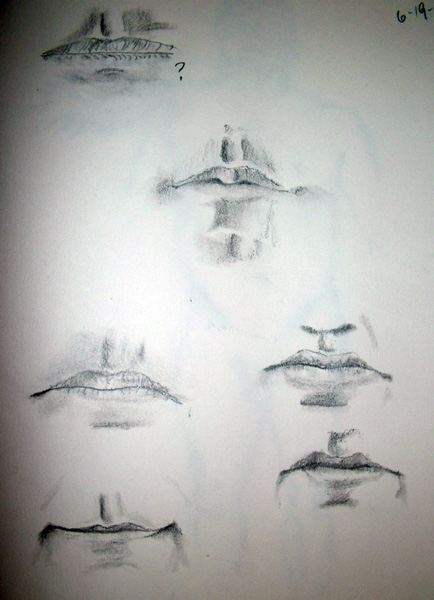
It seems as if I didn’t get a lot done today, but I did a great deal around the house that isn’t on my List. Niggling, yes. I actually sketched more than I’m showing, but this is a family-friendly blog, so you’ll just have to wait for the gallery exhibit to see the culmination.

One of those mouths is actually very accurate.

A strategy I’m going to try next is to trace the outline of the object that I’m working on and overlay that on my drawing , a way to tell where my eye/hand is missing it.

Can this be true?

This is a conundrum. Every day I receive The Writer’s Almanac daily email, and usually I read the title of the poem and plunge straight into the poem without seeing the poet’s name.

If the poem is striking, even in part, I play a little game with myself: is the poet a man or a woman? Is it possible to tell the poet’s gender through his/her use of language, choice and treatment of topic, attitudes?

I’m not talking about gender-specific poems, just general life kinds of things that could rationally have been written by either sex. (And of course, as I always remind students, the voice of the poem is not necessarily the voice of the poet: Was dear Emily actually dead when she heard that fly buzz?)

It is astonishing to me how often I am correct in my guesswork. Is there a gender-based difference in poetics? Or is Garrison Keillor just drawn to poems that reflect the poet’s sex?

Art & Fear: 3

Art & Fear does suggest a remedy for the problem of destination for your work:

A. Make friends with others who make art, and share your in-progress work with each other frequently.
B. Learn to think of [A], rather than the Museum of Modern Art, as the destination of your work. [p. 12]

And that exactly is what I have in the Lichtenbergian Society: a group of creative men who joke about their procrastinatory proclivities, but who are in fact a vibrant core of collaborators. The fact that we gather at the Winter Solstice to record our artistic goals for the following year, and to confess progress, or not, on the previous year’s goals is enough to make them my [A].

But of course we gather throughout the year, and many times the question arises, “What are you working on?” We don’t exactly trot out our work and pass it around like the Inklings did, although I do show some of my paintings, but just the opportunity to talk about our work is enough. We also have our blog to share on, and I usually post any music in progress on my blog.

I guess I’ve solved the [A]/[B] problem for my painting. After all, most of what I’m working on in that regard is for the Lichtenbergians anyway. It’s with my music that I haven’t solved the [B] aspect quite yet. It would help if the Lichtenbergians could play in a string quartet. Lousy slackers.

Summer Countdown: Day 38

Lichtenbergian goals:

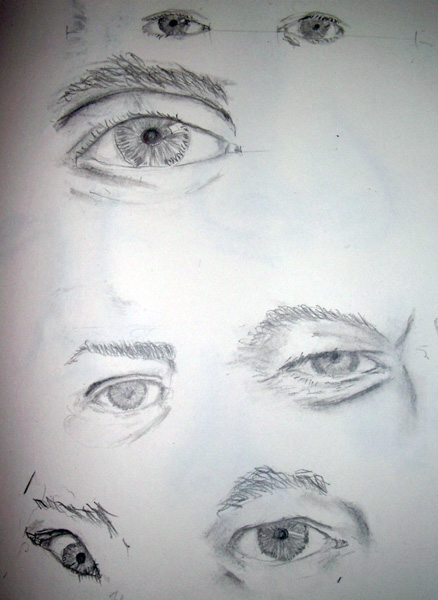
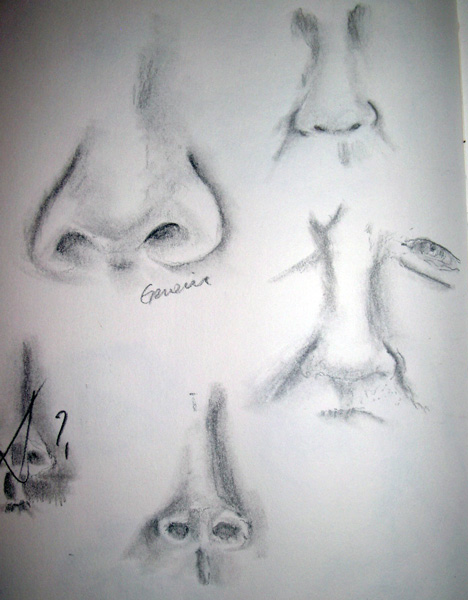
  • filled some pages of the sketchbook with studies of eyes and noses, both generic/anatomical and specific. It was interesting to me that while I think I was able to capture the specific shapes of various Lichtenbergian eyes and noses, I don’t know that you could identify the Lichtenbergian from his isolated feature. Mike’s eyebrows might be a giveaway, maybe. Or maybe I’m just not accurate enough yet.
  • read some more Power of Now and Art & Fear.

Today I’m working on mouths, and I may try painting some details as well.

Lichtebergian procrastinations:

  • reset the clay pots at the cardinal points of the compass deeper into the ground, so that I can mow over them. (These are the pots I put the citronella candles in.) Having mowed over one of them and nicked it still, I may have to set them deeper.
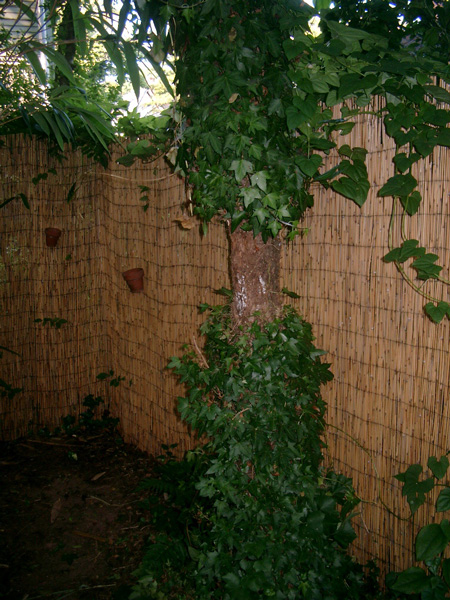
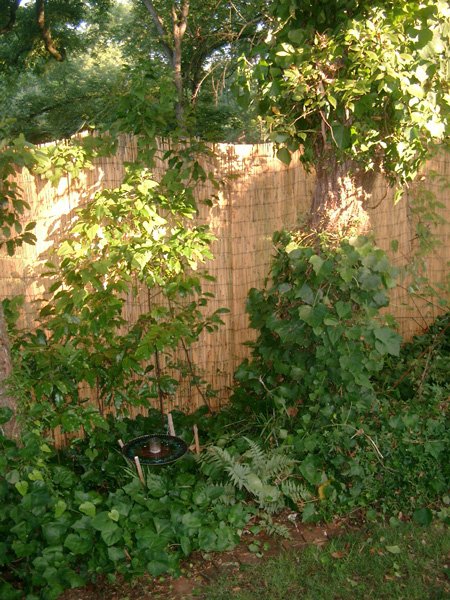
  • stripped ivy from the trees where it had taken over. This was not as time-consuming as I had feared: all that foliage is produced by very few strands, although on the cherry laurel up by the table the stems were as thick as a sapling. Still, it’s a soft kind of wood and easily cut and easily removed.

Art & Fear: 2

And artists quit when they lose the destination for their work, for the place their work belongs. [p. 9]

Longtime readers of this blog will remember the creative crisis precipitated by the decision of my friend Stephen Czarkowski’s not to return to GHP in the summer of 2008. He had asked me to try my hand at writing a symphony for the orchestra, and I had reached a point of having finished (i.e., stopped) the third movement and being stuck with the final movement when the news reached me. (The first two movements never got written.)

For most of my creative life, I have been guarded in my output. I am not a fast composer; I have to struggle for everything I write. And so it has almost never made sense for me to attempt to write something that I know will never be performed. A full-scale symphony? Who would play it?

So Stephen’s offer was a gift from the heavens. If I wrote it, they would perform it. I could write without holding back. In fact, having heard Stephen conduct GHP students in playing Strauss’s Death & Transfiguration, I figured there was nothing that came out of my head which would pose any difficulties whatsoever. The news that it would not be performed that summer was like hitting a brick wall. It meant that it would never be performed.

Whoever the new strings person was (and it turned out to be a former GHP student of mine), I would be his boss and not his friend: I could not ask him to devote so much class time to the performance of my piece without a very real appearance of impropriety.

It was more than a year before I wrote another note of music. The 24 Hour Challenge was an effort to move myself out of that dreadful stasis, and I think it succeeded in many ways. For one thing, I was able to take one of the pieces, “Club-Foot Waltz,” and turn it into the “Waltz for Bassoon & String Quartet,” which then became this spring’s “Pieces for Bassoon & String Quartet,” and which I printed out as soon as I got home on Tuesday and mailed to my former GHP student at GHP, since I am not his boss for the summer (and am in fact now his friend) and can ask him to read through a piece just as boldly as any other third-class first-rate composer.

The problem of destination is illustrated in my work by A Visit to William Blake’s Inn. As much trouble as I had finishing that, particularly the epic “Blake Leads a Walk on the Milky Way”, thoroughly documented on this fine blog, I persevered to the astonishing conclusion, because I believed that it would be performed. I believed that it had a destination. If I had known that no one would have the slightest interest in it, I would have shelved it.

Now you would think that I would learn the lesson from these two episodes that Bayles and Orland try to teach in Art & Fear, that you have to aim your work at a destination that may not exist in your current universe, but I have not. Maybe as I progress through the summer and knock out the Ayshire Fiddle Orchestra piece in no time flat, and suddenly have the skills and inspiration to finish the Epic Lichtenbergian Portrait (not to mention the necessary reference photographs (ahem, Mike, Kevin, Matthew, et al.)), then perhaps I will look around me and decide, hey, why not? I can throw myself into projects that don’t have a light at the end of the tunnel: the Symphony in G, the mini-opera Simon’s Dad, and whatever else I can imagine.

But it’s going to take a lot of success with projects that do have a destination before I trust the universe to create things that don’t.

Summer Countdown: Day 39

A slow start, but a start. I’m still in “getting down to business” mode, which includes running errands and tidying up my environment.

So for Thursday, June 17, I read and responded to Art & Fear, and did some reading in two new books, The Power of Now and Walking Meditation.

As for my creative goals for the summer, I did get three pages of sketches done: one line drawing, one gesture drawing, and some attempted details. No progress, really.