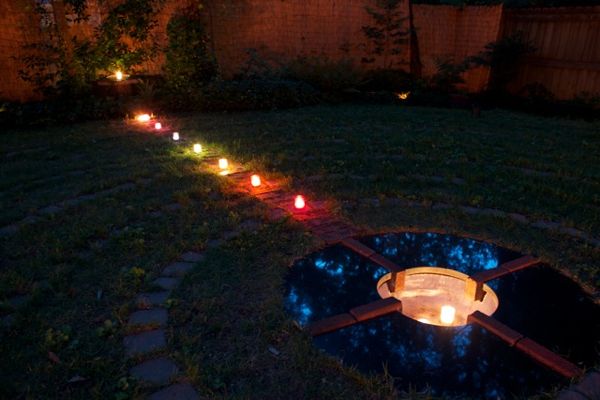
Labyrinth, 11/7/10

Those who have visited the labyrinth know well my chakra candles that I usually arrange along the western path:

Last summer I was cleaning up after an evening of quiet and meditation and I kicked the indigo/purple one. It broke. Not to worry, I knew I had a place to order one from.

Except it turned out I had to order a dozen. Again, not a problem. I’m sure I’ll find a place for the other eleven at one point or another.

However, a month or so ago I broke the red one. I decided against ordering a dozen red ones, I am trying to economize these days after all, and went rummaging around the house for a replacement. I found one of course—have you seen us decorate for Christmas?—but it was a largish round thing, not the same as the others.

This started me thinking. I decided to begin to replace all the votive holders with a random assortment of holders.

I rummaged some more and found a large square green one, actually a deeper, better green than the one I had been using.

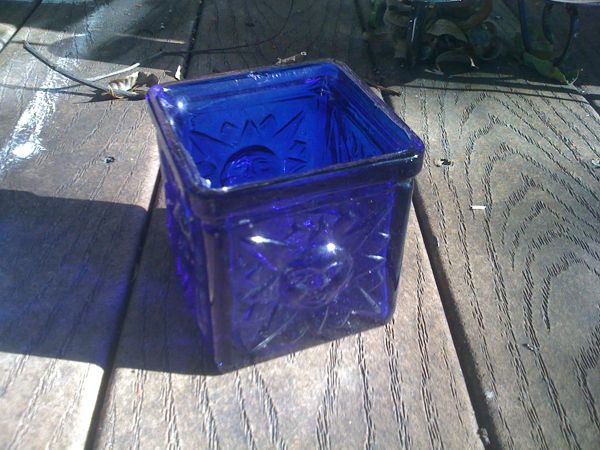
It had seemed to me for some time that my blue votive was quite weak, looking more white than blue, so that became my next quest. This weekend, we were antiquing in Greensboro, GA, and on my way out of the largest, junkiest store, I found this:

Beautiful. And at Target back into town, I found an orange one that is more traditionally shaped, but has decoration on it.

Now I’m looking for a brilliant yellow and a decisive violet/red-purple. Keep me in mind as you travel.

Cello sonata, take 9

I got back to work on the Moderato last night, and I thought this was interesting enough to write about. Your mileage may vary.

You may recall that last week I spent a couple of sessions just generating crap for the development session. I churned out variations of the two themes without regard to quality or how (or even whether) they could be used. I think I need to do some more of that, possibly tonight, but last night I thought I would evaluate what I’ve done so far.

I took my music Moleskine (where I sketch out harmonic ideas when necessary) and listed the sections of the Idea file that I thought were interesting/valid. For example, I’d write, “97-99, a gentler variation of the B theme; sounds like it might come near the end.” I ended up with about ten of these segments that had possibilities.

One in particular sounded like it might make a good lead-in to the recapitulation, so I opened up that file, moved what I had already written over by a couple of blank measure, and stuck the fragment in. Lo! it worked. And then another fragment, which I had marked as “nearly atonal, possibly a lead-in to the lead-in,” I stitched onto that one. And then, I stitched that to the lead-in to the recap that I had already written, and lo! it worked. So now I have a fake-out that jumps into a pretty wild variation before plunging back into the recapitulation.

It might be too powerful, i.e., the recap itself might sound a bit weak after so much sturm und drang, but on the other hand the main theme sneaks up on you, and you realize a bit slowly that you’re hearing it again for the first time.

More work is required.

I once was successful

For some reason, iTunes picked an old file of mine to play this morning, the bare-bones MIDI rendition of “I’d Never,” from Mike Funt’s zany A Day in the Moonlight, back when he still believed I could write songs for it in a timely manner. Foolish, foolish man.

Anyway, it reminded me of that song’s scabrous lyrics, how much fun they were to write and how wonderfully awful they were. The play itself is a Marx Bros. version of Edmund Rostand’s The Romancers, better known in its musical comedy version as The Fantasticks. The song was somewhere in the second act, I think, and was the Groucho character’s patter song about all his former loves.

At the risk of appalling my more sensitive readers, I append here the lyrics to this cringe-inducing song with the hope that it will distract you from my pitiful failure to make progress with the cello sonata.

1
There’s a lot you could say for Gertrudë
She was clean and she came when you called.
But I’m afraid I could not have been rudah
When I found she was totally bald.

CHORUS:
I would never (he’d never)
I’d never (no never)
deride or disparage an ex:
I’m such a defender
[last verse: and not an offender]
of the delicate gender,
[last verse: in all of their splendor]
my feelings so tender
for all of the opposite sex.

For Carol was crazy and Lucy was gay,
And as for poor Karrie, well, what can I say?
For as much as I’d love to have wrung all their necks,
I’d never, no never, disparage an ex.

2
And then I was dumped by poor Mimi
Because I failed one of her tests:
It was bad that I ran away screaming
When I found that she sported three breasts.

, CHORUS,

For Maggie was toothless and Eleanor lisped,
And Susan would sunbathe till burnt to a crisp.
Alicia most closely resembled T. rex,
But I’d never, no never, disparage an ex.

3
I was ready to wed my dear Julia,
But she threw a wrench in my plan:
“Oh darling, I’m sorry to fool ya,
But you see that I’m really a man!”

, CHORUS,

For Chloe was cross-eyed and Doris a drunk
And Rita regrettably smelled like a skunk.
So I’ll say it again – if no one objects,
I’d never, no never, disparage an ex.

4
Dissociative disorder Delores
Offered multiple ways to have fun.
When she sings it is always a chorus,
Till one of her pulls out a gun.
[Except when she flourished a gun.]

, CHORUS,

For Gladys had gangrene inside of her thigh,
And Molly made innocent child-er-en cry.
Though many have given me herpes simplex,
I’d never, no never, disparage an ex.

5
Romanian gymnast Ivana
Had many intriguing techniques.
But then she would take a banana and
Put you off of fruit salad for weeks.

, CHORUS,

Amanda had scurvy, Felicia was fat,
And Winifred would end a sentence with “at.”
Because with them all I had excellent sex,
I’d never, no never, disparage an ex.

6
Then there’s the lovely Vanessa,
a scrumptious, delectable dream:
Every time I’d begin to caress her
She’d grab both her buttocks and scream.

, CHORUS,

For Betty Ann’s body was covered in hair,
And you’d only date Natalie once on a dare.
Though mostly they’re known for their creepy effects,
I’d never, no never, disparage an ex.

7
I thought I could love Amaryllis,
A waitress I stumbled upon,
But then she would give me the willies
when she followed me into the john.

, CHORUS,

[huge catalog]
Leilani, Lolita, Letitia, and Lou,
Ula and Uma and Ursula, too:
For though they were total emotional wrecks,
And never forgetting the excellent sex,
I’d never, no never, (What, never?, Well, hardly ever)
I’d never, no never, disparage an ex.

Cello sonata, take 8

I promise that if nothing interesting happens in the next session, I’ll find something else to write about until I have a breakthrough.

Last night I was good to my word and worked solidly in the Idea file all night. I wrote about 70 measures of mostly unusable material. So that was good. I will do the same tonight.

I regard it as problematic that I keep hearing Brahms’ Cello Sonata No. 2 in my head rather than mine.

Cello sonata, take 7

I forced myself to work on the sonata last night, trying to get some feel for the development. I should have made myself sketch without any attempt of polishing, but I fell for the oldest trick in the book: “Hey, this sounds kind of good. I’ll plug it in and see how it works.”

The answer? Not so good. I have little tiny spurts of development that make no coherent thread. Again, some interesting possibilities, but it’s just chunks.

Tonight, forced march of improvising development. No polish. No clear addition to the piece itself. Onward!

Cello sonata, take 6

I woke up this morning with several possibilities for the cello sonata running through my head, both for going forward in the development section and for segueing into the recapitulation.

So far, neither has proven entirely satisfactory, but the morning’s work has moved me past what I accomplished last weekend. I’ve gotten notes on the page, breaking up what has become the hermetic “perfection” of what I have written so far. Does that make sense? If what I’ve written is good, and I don’t work on it for a week or so, then what’s there begins to sound as if it’s complete. How can I add to it?

Therefore, even though what I’ve written this morning is far from what I think I need to hear, it at least has given my brain something to reject and to improve.

Why don’t I post two bits, the original beginning of the development, and what I wrote this morning? The first is what I ended up with last weekend; the second is what I’ve stopped working on this morning, and I state up front that it is not good. As I work on it and get back into the music, it will serve as an interesting lesson in how I blunder my way into what sounds awfully organic and masterful.

Original | Saturday, Oct. 22 blundering

Today’s work is indescribably clumsy. Some interesting suggestions, but this will not be what audiences in our nation’s capital hear. This is what comes of trying to transcribe dream music.

Cello sonata, take 5

Not a lot of time to work tonight, but I thought I would at least pull out the first 36 measures and copy them into a new file, which I’ve named i. moderato_B_recapitulation.

For those who don’t know what I’m talking about, here’s the quick and dirty explanation. (For those who do, you can skip to the break.)

A sonata is generally a three-movement work for solo instrument and accompaniment. The first movement of a sonata is usually in what is called sonata allegro form, and this is what it looks like:

(You can clink on the image to go to a ThinkQuest project that explains sonata allegro form in terms of the symphony, which is a four-movement sonata for an orchestra.)

My principal theme (also called the first theme or the A theme) is the big, swashbuckling opening theme. Loud, violent, in A minor, mm. 1-16.

There is a bridge passage, the settling down to F major, mm. 16-20. My second subject (or B theme) is the beautiful little tune from mm. 21-36. It is a perfect contrast to the principal theme, both in character and in tonality. Usually the second theme is in the dominant key from the principal theme, and the reverse tonality. In other words, if the piece were in C minor (like Beethoven’s Fifth Symphony), that means the principal theme is in C minor, and the second theme is in G major. Here, my second theme, as I mentioned earlier, is in F major when perhaps it “should” be in E major.

However, there aren’t really any “shoulds” in sonata form, something I wish someone had told me before I started listening to symphonies and concertos and sonatas trying to pick out this exact, pedantic structure. Not many works adhere to it precisely.

Mine certainly doesn’t. For example, there is no “closing section” between the second theme and the development. There’s not even a cadence. It just bleeds directly into E major (finally) and we start playing with the two themes right away.

All of this is to say that I copied the first 36 measures, my exposition, into a new file. The recapitulation of a piece is usually a more-or-less exact repeat of the opening, except that the second theme is held to the original key. In my case, I transposed it up to A major.

And here’s the strange thing. It is a totally different thing. Even if I play just the second theme without the new bridge passage to get us from A minor to A major, you can tell it’s not the same. It’s not as full and warm, for one thing. It’s higher and tinklier and not as expansive. I may have to think about this. The main determinant will be how I think the movement needs to end. I may choose another key, or I may choose to rejigger the whole theme so that it sounds completely new and wonderful before tying into some kind of end.

At the moment, I’m leaning towards a quiet, gently moving end.

Fear

Here’s another frightening thing: the music won’t stop. After spending the weekend immersed in the cello sonata, I find that returning to work is a major terror. What if I lose the thread, the inspiration, before I can get back to the score? How can I pay attention to shelving books when there’s the music waiting for me?

And every second, that music is roaring in my head, wanting to get out, wanting to push forward, to expand, to grow, to become complete.

I’m trying to regard it as merely a new phase of the process that I have to learn to deal with. But it’s frightening.

Cello sonata, take 4

This post is all ex post facto: we have absolutely no internet connection in the remote cabin we’ve rented for the Second Annual Lichtenbergian Retreat. I’m trying to record thoughts as I go along, mostly to avoid working. Enjoy.

Friday, October 15

It is very frightening to sit down at your computer and keyboard on a brilliant fall morning in the mountains. Let me put it this way: I am very frightened to sit down at my keyboard. Upon arising (after a late night hot tub discussion on the nature of God and our ability to understand same), I have gotten my Lichtenbergian travel mug filled with coffee, come downstairs to the play room and set up my computer and keyboard to begin work on the cello sonata.

And that’s it. A couple of amiable good mornings to my fellow Lichtenbergians, and they all vanish. Everyone’s working. It’s dead silent in the cabin. We came to work, and now we’re working.

So I’m frightened. I quickly resolved a couple of harmonic issues in the Andante/Elegy as it stands, but now I’m faced with what to do with that abrupt change. Do I continue working on the Andante, or should I play around with the opening Allegro? This absolute freedom, compulsion, to work is very very frightening.

I open a file that I started on the Allegro, a very simple opening. Now I wonder if this is the opening movement for a sonata that ends up with the Andante I already have. Should it open more vigorously? Or is this quiet, gentle melody what needs to lead into the elegy of the final movement?

I suddenly remember I have not taken my meds for the day.

I’ve added one little measure to the gentle Allegro and a whole landscape opens up. That’s frightening as well.

Noodling around is all fine and good, but eventually, if one is composing a sonata, one must settle on a theme and figure out how it can be developed. Indeed, one must settle on two themes. And develop them both.

Close the simple opening (we’ll call it Allegro_A) and open a blank file. Hammer out something gangbusters.

10:30ish
So, in playing with Allegro_B, I’ve written a great measure that must happen somewhere in the thread of the piece, because it’s not an opening measure.

10:51 (<–I’ve decided to start time-stamping this)
New futzing, and this time it sounds like an opening. I was semi-trying not to open in a minor key, but this is what’s coming out. Very majestic, very Romantic. I think I’m going to go with this for a while. Maybe the gentle Allegro_A theme can serve as the contrasting B theme for this opening.

11:40
It’s now a Moderato, not an Allegro. I’m beginning to puzzle out the possibilities of this very stark theme. Do not be fooled. I am only to measure 14. Kevin tried to distract me, and I countered by puzzling him with what I’ve written.

11:57
Lunch time.

1:00
Lunch, then a walk by the creek in flawless sunshine. I kept hoping that further ideas for the stark theme would pop into my head. Hoping, not working. Instead, the fragile second theme from the Andante/Elegy keeps nagging at me. Still, I think what I shall do for another couple of hours, before the hot tub claims me and I have to cook supper, is to develop chunks of variations that I can use later.

For both the Andante and now the Moderato, I have two separate files. One is the piece itself; the other is an “ideas” file where I can play around and put out garbage without worrying about having to reclaim or undo what I’ve done. I generally don’t delete anything from the ideas file; stuff just piles up. Often I’m able to go back and snag some of the detritus for other stuff. Such is the Way.

1:50
Holy smokes. The B theme has appeared. (I tried the original Allegro_A theme to see if it would work, but it didn’t. It will have to wait until the Cello Sonata No. 2.) This new theme is simple and lovely, a complete contrast to the stark A theme, which is as it should be. The relative keys are not classically correct (A minor to F major, instead of E major), but it’s too pretty to mess with. (I tried taking it down the notch, but it didn’t work, and F is such a bright and pretty key that I’m leaving it alone.)

2:32
It’s very odd not being able to interrupt myself with email. The B theme is easy to extend and sustain the pretty quality, but there has to be more to it than a Hallmark sensibility. Plus, I have to herd it towards the development section, and then where will we be?

Saturday, October 16

11:20
After a long and interesting night, I am circling back around to look at this work. I listened to the two fragmentary movements repeatedly last night, and was always impressed with what I heard. I think I’ve fixed the bare spots in the Elegy, and the opening Moderato is very solid. At the moment I find I am transfixed by the Moderato B-theme. It is pure and delicate, simple sweetness, and a perfect contrast to the opening. The next question is whether it can hold up its end of the conversation.

2:47
Short nap, a little lunch, a little Lichtenbergian distraction playing a neat card game with Kevin and Craig. Back to work, approaching the development section of the Moderato. This is where the Hallmark theme has to pull its weight. There’s no demarcation of the development in the classical sense; we just kind of blend into it before we know it.

I worry that once again all this is not very developed, but Stephen asked for about a 12-minute piece, which means that I have to get the ideas out there quickly and then develop them rather immediately.

4:37
Knocking off for the day, and by extension, for the weekend , after getting a nice little notch cut out of the development. Not set in stone by any means, but enough to get me through the door.

I think what I need to do next is go to the Ideas file and just play around with development ideas and have lots to choose from.

Here it is so far, the Moderato. (And the score.)
Cello sonata, take 3

I wasn’t going to share this movement as I went along, because it may be good enough that you would want to hear it whole and complete the first time. But then this thing happened this morning.

There I was, cleaning up some weak-sounding bits and moving forward, when suddenly the music decided it needed a change, so it drew itself to a fermata, then double-barred itself and began a completely unexpected B section, completely different in character and goals from what had come before. This is not necessarily a problem, because ABA is a perfectly respectable form, but I hadn’t planned on using it here.

So here’s my dilemma: do I accept this new section and try to work with it a while before heading back into the higher energy of the A section, or do I squash it and channel the first part into further explorations of itself? This is the last movement of the piece, so it should sound as if it’s closing out whatever has come before, and I’m not sure the new section contributes to that feeling.

At any rate, here it is. If you want to wait to hear it finished, don’t click. If you want to give me advice, plunge right in.

III. Andante (Elegy): score | mp3