Liebestod

Oh my God: how could I have forgotten the “Liebestod”?

Today, I was toodling around doing my errands, stocking up on tonic water for the long weekend, that kind of thing, and my iPod chose John Adams’ Short Ride in a Fast Machine. Very fun piece, and thrilling, and I was driving along, trying to remind myself to go pick up the laundry too, and then I began to imagine some kind of video to go with the music: a short ride starting at Battery Park in Manhattan and proceding across the continent, zooming across the plains and through the Grand Canyon, ending with a swoop up the side of the Rockies and an abrupt fall down the hills of San Francisco to a sudden stop at the Pacific Ocean. Could be a lot fun for someone with imagination and enough computing power. One of you needs to get on that.

Anyway, I was thinking about computer-generated videos for classical music, and I happened to recall early attempts at this kind of thing, back in the 80s, including one for Wagner’s “Prelude and Liebestod” from Tristan und Isolde that seemed fairly accomplished at the time. (The author of that particular video seems to be Ron Hays, from a quick Google search.)

I found myself wondering whether in fact that video would appear as accomplished now. (It’s not online, alas.) What would be possible with today’s technology that could match that soaring, gorgeous sound?

That’s when it dawned on me that I did not in fact own the “Liebestod.” Wagner is a difficult proposition from any angle: either you hate him or love him (“Wagner’s music is better than it sounds,” smirked Mark Twain), and even if you love him, you either own whole days’ worth of his music or Top 10 compilations.

Thus it happened that I owned Solti conducting his way through the hummable bits of the Ring Cycle, but nothing from Wagner’s other works. Not a problem: that’s what iTunes is for, ne-c’est pas? After twenty minutes deliberation, I downloaded Daniel Barenboim and some French orchestra playing bits from Meistersinger and Parsifal and finally Tristan und Isolde.

I’ve been playing it all evening, this “Liebestod,” and I have to tell you that it’s one of those pieces you should not play while driving, because you risk running into something when your eyes roll back in your head.

Wagner was a damnable man, personally vile in the extreme, but heavens, what music! A simple motif expands, growing ever and ever more passionate until it effloresces into literal waves of sound, which crash against your ears again and again and again, and just when you think the music cannot take you any higher, it does, in a climax that is, not to put it too delicately, orgasmic.

You don’t even have to know the plot of the opera: Tristan goes to pick up King Mark’s new bride, Isolde. Abetted by a servant’s love potion, they fall in love on the boatride back, but she goes through with the marriage. Alas, they cannot keep their hands off each other, and he is wounded by one of Mark’s minions. Isolde stands over his body and sings this music, willing herself out of this mortal life and into a whole other, higher plane. (“Liebestod” means “Love-Death.”)

There is of course, in one irony, a new movie opening this weekend with a modified version of this story, but somehow I doubt that it’s going to end quite so transcendently.

The other irony of this post is that Birgitt Nilsson, the great Wagnerian soprano, died over Christmas; her death was announced yesterday in the Times. I also downloaded her performance of this from the 1966 Deutsche Grammophon recording, just out of curiosity; I am not one of those who own days’ worth of Wagner’s music. People, even if you don’t like opera, this piece will leave you goggle-eyed and weeping. There is an irrational ferocity in the accompaniment that Nilsson just soars above as if it were nothing, as was her wont, apparently, and when she hits that climax, she threatens to drag you into that higher plane of existence with her. Sumptuous stuff, just sumptuous.
Lamest. Ad campaign. Ever.

OK, so this is a totally irrational rant, but something in me snapped and I just have to get this out of my system: Yo, Georgia Natural Gas, what is up with that natural gas dude?

Is that not the lamest ad campaign ever? It’s not witty, it’s not retro, it’s not subcultural. It’s just retarded.

First of all, it’s a guy in an Izzy suit, only with a face cut out so you can see the poor bastard. What kind of advertising company in Georgia abrades the public’s consciousness with memories of Izzy? A retarded company, that’s what kind.

Secondly, this freak’s little pronouncements on his billboards are not pithy or cute. They’re just retarded.

The whole thing is so incredibly lame that you have to wonder, what were they thinking? The goal could not possibly have been to entertain us, or to charm us, or to endear themselves to us, because the whole concept is retarded. What are they trying to do? To enrage the public so much that their only recourse finally is to climb the billboards and deface them with spraypaint? Because that’s what I’m about ready to do.

You know what would make a good website? I mean, in a sick, retarded kind of way? Go to every single one of this creature’s appearances and stalk him. Really: get a friend, and both of you show up at every single event, smiling and beaming and getting both of your pictures taken with him. Every time. Pictures of you hugging him, kissing his cheek, with your face painted blue. Make a big hairy deal out of it. Ask him when his next appearance is, and be there. If he ever makes up a date, claim that you waited hours for him when you see him at his next gig. Blog your adoration of the Gas Guy. Invite others to share in your fascination. Watch the webclicks mount up as all of Georgia laughs itself silly over this retarded, retarded advertising trope.

And maybe then, and only then, will Georgia Natural Gas blow this little fart out.

Music for the soul

A couple of summers ago, I went to check on how World War I was going in the classroom of my friend Dave Adams. When I got there, Germany was still posturing, the U.S. was still smug and quiet, and everyone still hated France. While Europe parleyed, music played. I complimented Dave on the music, and he offered to make me a copy of the CD, which he had put together from his collection. He called it his Music for the Soul CD; its contents represented music that resonated deeply for him.

The idea of creating a CD that was filled with music that had special meaning for your soul is right up there with the “10 books for your desert island” meme, but unlike your mythical shipwreck, this is one you can actually do, although I have to say that if you don’t have iTunes, you really really want it on your computer before you try.

I don’t think it would surprise anyone to find that mine is devoid of pop music.

Here’s my list:

  1. Allegretto, mvt. 1 of Symphony No. 2 in D, Sibelius
  2. Prelude, mvt. 1 of Cello Suite No. 1, J. S. Bach
  3. “Juice of the Barley,” an English country dance
  4. Allegro, mvt. 1 of Piano Concerto No. 2 in b minor, Dohnányi
  5. “The Hours,” from the movie soundtrack of the same name, Glass
  6. “Komm, eilet und laufet,” mvt. 3 from Easter Oratorio, J. S. Bach
  7. “Towards the Dream,” from Dreamtime Return, Roach
  8. “Prelude and Fugue No. 7 in A major,” from the 24 Preludes and Fugues, Shostakovich
  9. Fratres, Pärt
  10. Canon in D, Pachelbel
  11. “The Breaking of the Fellowship,” from The Fellowship of the Ring, Shore

The amazing thing about this lineup is that it seems all of a piece. There is contrast between tracks, but there’s an odd coherence about it all. Even the last track, the Fellowship of the Ring piece, segues neatly back into the first track, the Sibelius. One thing that helps the coherence is that most of the works seem to be related to the key of D: D major, b minor, A major, etc.

This CD must truly be my music of my soul, because I never seem to tire of it. I have gone months at a time with nothing in the CD player in the car but this, and it never palls. Even the child has noted that there’s something interesting about the CD, both as a whole and in its parts.

Stylistically, of course, it’s all over the place: baroque, post-romantic, minimalist, new age, movie music, for god’s sake. What could possibly hold it all together?

And why is this music for my soul? What does this say about me? I shall hazard a guess. It’s complex, esoteric, cerebral. It’s melancholy, mostly underneath but occasionally on the surface. It’s coherent, no 12-tone horrors here. It moves, none of it is static, the Glass, Roach, and Pärt notwithstanding. And much of it is inward-looking. Yep, that about sums me up.

Random reminders

Today I was running off some News from the Media Center newsletters and putting them in teachers’ boxes, and a few memories flooded back: I print my newsletters on paper I’ve recycled from the copier at the Governor’s Honors Program, so things will show up on the backs of stuff that remind me of what an incredible intellectual playground GHP is.

Today, there was an entry on war from the Stanford Encyclopedia of Philosophy, from Daniel Byrd’s course on Just War; a piece of music score paper with handwritten music theory assignments; the Black Knight scene from Monty Python and the Holy Grail, in Latin, along with the lyrics to “Oops, I Did It Again” and “We Are the Champions”; an algorithm for a “super-random” number generator; and pages from my own “Sonnet 18” in progress.

There might just as well have been material on emotional attachment disorder, Anglo-Saxon poetry, comic book heroes, the history of the Bible or the Koran, microgenetics, Shakespeare, architectural elements, business law, the Arabic alphabet, Machiavelli’s The Prince, orchestral parts to Stravinsky’s Firebird or Haydn’s Lord Nelson Mass, personality traits, or Stanislavsky’s acting theories.

This is the kind of stuff that fills the six weeks of every summer in Valdosta as we make our way through the program. Just imagine the kind of student who eagerly devours this material, imagine nearly 700 of them, and imagine the teachers who bring it all to them. This is the life I lead each summer.

Theater drops Klan play | ajc.com

It seems (Theater drops Klan play | ajc.com) that the Arts Station theatre got cold feet over hosting a staged reading of a play about Klan rallies at Stone Mountain. It seems that the opening monologue was not only “racy,” but also “inciting, and slanderous about Jews and Catholics,” according to the director. So they’ve canceled the reading.

I have some questions, since I don’t know any of the people involved, nor have I read the script. I did, of course, run the Newnan Community Theatre Company for over twenty years, so I might actually have a little insight here.

First of all, every theatre has its mission. Ours was to provide a wide variety of theatrical experiences for our audiences. Notice the plural. We didn’t have an audience, we had several different audiences. This allowed us to do whatever interested us as artists, since we were not interested in limiting ourselves to material that it was safe to bring the kids to. (I use the past tense here because of course I cannot speak for the company in any official capacity, currently led by the inestimable Dave Dorrell, but they’re doing just fine without me.)

So my first question is, What is Arts Station’s mission? Is this the kind of play they seek to do? If not, then why did they agree to the staged reading? If it is, then why back off?

Did no one read the play before they agreed to do it? Did the playwright tack on the monologue after they got into rehearsals? How did the “problem” with the monologue go unnoticed until announcements had been made?

Was this an actor problem? Did some actor suddenly decide that “he” couldn’t say those words?

Why the sudden panic over community relations? Are their audiences so generally unsophisticated that such venomous language genuinely offends them personally? Their lineup is hard to read, but it doesn’t seem to be very “hardhitting.” That’s not a condemnation, by the way; it’s all a matter of what your mission is.

Aside, re: the language issue: there’s a good young adult novel, The Day They Came to Arrest the Book, by Nat Hentoff, about the attempted banning of Huckleberry Finn on the usual bogus racial issues, and for me the climactic moment is when a young black student addresses the school board and tells them, “I’m smart enough to know when I’m being called a nigger, and that’s not what this book is doing.” I’ve always assumed any audience that I’ve attracted is smart enough to know that the language in the play is not being addressed to them personally, nor is it being delivered personally by their friends and neighbors.

Still, this was just a staged reading, an agreement that you’ll give the playwright a chance to hear his words out loud, to hear if they work, and to share them with an audience who, because you’ve taught them, understand this is a work in progress. You even put up big red posters in the lobby warning them about the language and subject matter.

And if the opening monologue is too much, that’s when you work with the playwright to say that you understand what he’s trying to do, but it’s not working the way he wants it. Or something. You don’t tell him that you just can’t say those terrible words, because the time to do that was before you agreed to the reading.

And you don’t put out disclaimers that it’s the playwright and not you who’s doing the offending, because again, you agreed to an artistic partnership, and part of that partnership is that you agree with his message. You can warn people to gird their loins before the curtain goes up, but apologize for what you’ve produced? Grow some artistic balls, people. (That’s a generic commandment; again, I have no details about the situation at Arts Station, so I would not presume to issue directives to them.)

One more set of questions: Was this a board thing? Did some board member get antsy and then worry began to pile up and then panic began to set in and then “it was decided” that it would “better” if they didn’t go ahead with this thing?

Ah, well, who knows? Theatre companies are precarious, byzantine organizations, and those like Art Station who actually do provide playwrights with venues for new work are to be applauded. It’s just that when something like this actually hits the newspapers, unlike, say NCTC’s production of Pericles, which hadn’t been done anywhere in the Southeast at the time, or our world premiere of David Hyer’s Lying in State, currently playing at the Barter Theatre in Abingdon, VA, nor even our Mozart’s Marriage of Figaro, with a new translation, none of which got any coverage at all, then one does have questions.

At last it can be told

You know, that son of a bitch George Lucas would never return my calls, and now he’s finished up the whole cycle with bunches of light sabre fights instead of a deeply mythical twist.

Disclaimer: at this point, I haven’t seen Episode III. I am satisfied that it is better than the first two (I believe Buckaroo Banzai is better than the first two, and that is one lameass movie!), but my current rant has not been influenced by anything so vulgar as actually having seen the film.

So how should it have ended?

First of all, we have to go back and change Episode II as well. That movie was interesting for about ten minutes, when Count Dooku told whoever he was torturing, was it Anakin or Obi-Wan?, that he had built the clone army to fight against the Sith, since the Jedi Council was so obtuse. There was an interesting plotline: three sides to the upcoming cataclysm, one of them a renegade Jedi. Is he fighting for or against the Sith? Is he or isn’t he a Sith himself? You see the suspense that we could have been treated to, not only in Episode II but through much of Episode III as well. But no, Dooku was lying, of course, and the whole movie deflated.

Instead, imagine we’ve plunged into Episode III with this massive round of combat, intrigue, and betrayal going on. You got the Sith Lord, the Senate, Dooku and his army, the Jedi Council, replete with Yoda, Obi-Wan, Anakin, Mace Windu, Datare Gister (the “Fat Knight”), and the whole gang. Padmé and Anakin are married, secretly, and she runs to hide (on his orders) from the carnage as one Jedi after another is betrayed.

Things get more complicated till we get to where we need to be, i.e., Palpatine is Emperor and Sith Lord, Dooku is defeated by Anakin, and finally we have Anakin fighting two of the remaining Jedi, Obi-Wan and Datare Gister, on the edge of the volcano. He taunts them with the classic “No man may hinder me,” and of course Datare Gister, the Fat Knight, pulls off the Darth-Vader-like mask he’s always worn, and of course it’s Padmé, fat because she’s gi-normously pregnant. She stabs at him, he falls in, she goes into labor, wrap it up quick and leave it there. We don’t have to see it all, George. We know what happens after that. We saw Episode IV-VI, remember?

So anyway, I’d like to thank the Academy, and all the little people.

Reading the frogs

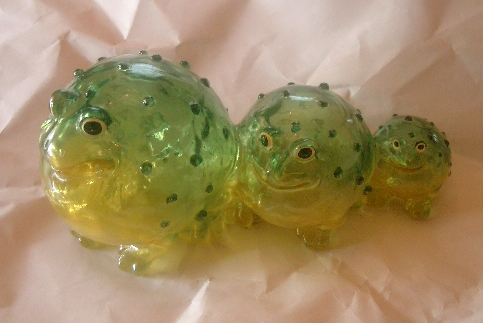
Ponder this:

I mean, what the hell, right?

This object was discovered in our local Big Lots, where truly one can find some beautiful things. This was not one of them.

It’s plastic, of course, and it was made in China, of course. But why? Bear with me here, there’s a lot to unpack.

If you go to Big Lots or Wal-Mart or Target looking for a spatula, you will find spatulas in varying shapes and sizes. A spatula’s a spatula, and the amount of thought that goes into the design varies with the presumed “reader” of the spatula. Basic flat spatule, metal or plastic, slotted or not, depending on the intended use; basic stem; basic handle. It is a utilitarian object, one that does not require a lot of thought as to its design. Design has to be deliberately applied to a spatula above a certain level (and I’m ignoring industrial design here, humor me.)

For example, beyond the basic metal spatule/black plastic handle concept, you may get different colors as we move up the design scale, in case your kitchen utensils need to contribute to the ambience. And sometimes, you may get that frisson of delight as you come across Michael Graves’ stuff in Target: oh, look, he’s designed the spatula. Isn’t it pretty? And if you move on up to Restoration Hardware or some other really trendy boutiques, the spatula is no longer merely an utilitarian object, it is an objet.

But for it to get that far, someone has to push it. The spatula doesn’t require that level of design to exist. No one has to suffer any artistic angst to get it out the door.

This is not the case with our little frog friends. Our little frog friends are not utilitarian in the least. They are, as hard as this might be to believe, decorative. There is not a reason in the world for them to exist, except for one: someone thought that people would want to buy our little frog friends in order to bring beauty into their lives.

Well.

In order for our frogs to exist, someone had to think, “Out of all the limitless possibilities of the universe, what I think would be best to create would be three puffed up toad-frog-things, in diminishing sizes, made of transparent injected plastic. Hollow, yes, that’s good. And gentle, anthropomorphic smiles on their faces. But otherwise not really recognizable as any member of the genus Rana as we know it. And to make it really pretty, tint the plastic so that it goes from apple green on top to chartreuse on the bottom. We’ll have to handpaint the eyes and lips, though.”

Lips??

So the artist goes to work creating this objet, and then all the terrific machinery of industry has to swing into action to create the molds, the plastic, the assembly line, etc., etc., and then the Midwestern Home Products company of Wilmington, Delaware, has to import them and distribute them. The questions still crowd in: did these go straight to Big Lots, or did they try their fortune in some tonier place first? Did Midwestern HP (of Delaware), purveyor of other fine products, cause this to be created? (There is some evidence that they did.) And if not, then who in China thought that the American public had a heretofore unidentified need for plastic frog triplets?

There is much about our little frog friends that might be understandable, if not forgivable, if they had been made by some artisan, hand-made-by-hand as we used to say in the costume shop: their squalid cheerfulness, the inexplicable bloated forms, the bizarre, hedgehog-like warts. If we knew that this was one of a kind, or maybe one of a limited series perhaps, from the hands of a not-very-competent glassblower, for example, we could wrinkle our brow, smirk in a self-satisified and über-conscious manner, and let it go with a knowing laugh. The creator hit a dead end. He screwed up. It happens, and you shouldn’t put it out there to be bought, but there it is.

But it’s not. It’s mass-produced. There have to be hundreds of these things, if not thousands, that were stamped out of the assembly line and shipped off to beautify the world. I for one cannot comprehend this.

It produces in me the same feeling I get when my wife and I go antiquing. There, on dusty and unregarded shelves, are legions of tschotschkes produced by the same inexplicable process that produced the frogs. They are without merit, and they are abandoned. No one is going to buy them, ever again. They have no cachet, they are not collectable, they are not even kitsch. They are, to be unkind, jetsam.

This has always caused me a little distress, seeing all this junk just sitting around these shops. It’s not that I empathize with the tschotschkes, you should know me better than that, it’s just the whole Darwinian waste of it all. It’s as if society, in the hopes of achieving some items of permanent beauty, spawns all this crap just to make sure that something survives.

And there’s the appalling thought that for these things to have arrived in the junk shop, someone had to buy them first. That is, someone once thought these little pieces of landfill were beautiful enough to bring into their lives to enrich them. And then someone thought they were beautiful enough not to throw away, but to buy, at whatever discount rate, in hopes of reselling them in the shop. Merciful heavens. What would dear Oscar say?

Still, I suppose I could look at it optimistically: so strong is the creative spirit in humans, that even people who are hopelessly second-rate artists force out these pitiful objects in the belief that they are beautiful. Do they ever realize that they’ve failed? And the people who buy them: are they abject Philistines, or is the human need for beauty so strong that people respond to it in even the most feeble embodiment? Should this objet distress us, or should we rejoice in our little frog friends as representative of humanity’s most divine impulse?

What to do with smart illegal immigrants

You will want to go read this article: La Vida Robot. Go ahead. I’ll wait.

Wasn’t that the most wonderful article? Did you click on the scholarship link before you came back here?

This would be the best part of having won the lottery, reading a story like this one, and before you even get to page 2 of the story, click on that scholarship link and donate your little heart out. I could not only pay for their education, but pay for their access to appropriate legal counsel, and perhaps alleviate some of their families’ problems. And what would it cost? Not even half a million. If I just paid for their school, it would only be about $200,000. I’m assuming their legal counsel would add another $100,000, lawyers being lawyers.

Incredibly, there are those who read this story and who have a different reaction. There are those who read this article and take umbrage that anyone would want to allow these illegal immigrants access to American education. Why should we allow these wetbacks to take one of the limited state school slots in place of one of “our own”? Why should we spend our tax dollars on these people, these undocumented losers who sneak across our borders and steal jobs from honest Americans?

Or, to put it another way that probably the wingnuts wouldn’t, why would a nation like ours seek to embrace the best and brightest minds we can find and provide for their future, here, with us?

I put my money on the future with the best and the brightest.

Bang on a Can

OK, new topic. We all have daydreams about what we’ll do when we win the lottery. I’m putting mine on my blog as I come across them.

Today, for example, I received a very nice invitation from the folks at Bang on a Can, the new music concern in NYC. They’re having a fundraiser in conjunction with Bob Hurwitz of Nonesuch Records, on Tuesday, April 19, 2005, and I thought, why not? They’ve done some interesting things in the past, although frankly much of it is earsplitting, but hey, I’m always ready to be intrigued, and since money is no object now that I’ve won the lottery, let’s do it.

So I figure we’ll do it up right: a $10,000 Bang Benefactor donation, which entitles me to a 10-person table for drinks, dinner, and the concert, plus luxury accomodations, meals, and tickets to the BOAC Marathon in the Berkshires this summer, plus season-long recognition as a sponsor, plus four tickets to the BOAC All-Stars concert on April 29. That’s a pretty sweet deal.

This is assuming I can find nine other people who would like to attend with me. Perhaps I could put an ad in the Times-Herald:

Wanted: Adventurous persons who can stand new music, to accompany local aesthete to dinner and a show. Apply at P.O. Box 1039C.

I keep buying CDs of new music, trying to keep up, seeing if concert music is making any progress in reclaiming the human ear after losing it so disastrously with that soulless sojourn into serialism in the middle of last century. So far, it’s pretty hit or miss. Any one of the pieces I’ve heard that have been written since 1980, say, can be interesting in itself, but when you start lining them up and comparing them, most of them are much alike. Too much brass, too many broad leaps in the “melody,” too many 2nds and tone clusters in the harmony. As they cycle through the iPod, I find them impossible to identify, just so many angst-ridden tone poems.

And what are we to make of John Corigliano’s comment [pdf interview] that the 2004 Pulitzer Prize for music, awarded to Paul Moravec’s Tempest Fantasy, startled him because of its sunny nature? “I’ve never in my life ever seen a Pulitzer Prize go to a piece that is effervescent, not for the last 40 years,” he mused. Apparently recognizing that the overwhelming tone of much new music is tortured, he adds, “I think that it’s very important for us to have that rich experience in art and not to think of art in this romantic twisted view that art is only about anguish and angst. It isn’t. The best works of art of the 18th century were often comedies.”

Still, some new music can be exhilarating, and my official position is that people should keep writing it, because eventually some of it is going to work. It’s like when eminent musicolologist Prof. Peter Schickele refers to the “lesser but nevertheless competent composers that dotted the musical landscape of the Age of Enlightenment” in his lectures on P.D.Q. Bach: I think it takes all the ballast of less competent work to produce the geniuses of Bach (P.D.Q. and otherwise) or Mozart.

So, buy the $10,000 ticket, I say, and support new music.

This thing is taking place below Houston St., so clearly we’d need to stay at the Soho Grand, which is a really cool hotel. My treat. Since it’s on a Tuesday night, we’d have to fly in that day and back out the next morning so that people wouldn’t have to miss that much work. Not me, of course. I won the lottery and don’t have to worry about such things.

Writing on paper

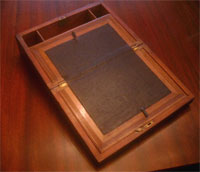
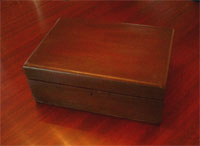
The writing desk, closed
Here is the antique travel writing desk that my wife gave me for Christmas. (I have a thing for old, wooden boxes.) It’s about 12 inches wide, 8 inches long, and 4-1/2 inches tall, much bigger than a Mac Mini. It has a lock, but we do not have a key.

The outside is plain, unadorned, smooth wood, perhaps cherry. We know nothing about it, not when it was made or by whom, or where.

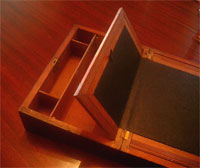
The writing desk, open
When you open it, you find that the two halves are not split evenly across the box, but at a slant, so that when it’s fully open the inner faces slope up to the inkwells and pen holder.

Whoever owned it before me had replaced the writing surface, no doubt leather and no doubt eaten away, with a nasty black felt, attached (as it turned out) with a spray adhesive. At least it was easy to remove, and I replaced it with real leather, firmly glued on with craft glue.

The writing desk, with lid open
Here you can see one of the lids lifted up to reveal the storage beneath. The lids are made of oak, with four or five fluted grooves cleanly and precisely etched around the writing area.

The two lids are held in place by the single piece of leather. The bottom half has a small brass latch that holds the lid in place as you lift it, the actual top half of the box, back into place.

Earlier this week I noticed that the long storage area in the middle had little notches on the side panels, which suggests to me that there was another little piece of wood that rested there, which makes sense. Pens could rest in that shallow area and not get banged around so much. I’ve bought a piece of thin birch plywood, some stain, and some red suede leather, and this weekend I will recreate that little shelf.

It was earlier this week that I actually got to put it to use. I was home all week with strep throat, and by Thursday I was looking for something to do. In the mail, I received a nice thank-you note from Paula Chambers, the fabulous once and future media specialist for the Governor’s Honors Program. She was thanking me for making the trek down to Bainbridge for her retirement party, and I thought, I know, I’ll write her a letter.

It must be understood that I am a stationery junkie. I love beautiful, elegant, or unusual stationery. I have lots of it.

But I do not write letters. Who does? And to whom? Almost all of the people with whom I want to share my thoughts are at the other end of a very short stream of electrons. Writing a letter is now a special effort for a special occasion… like having strep throat, I suppose.

So I fetched my best stationery: gray, 100% cotton rag paper, my name nicely stamped in dark green ink; envelopes lined with dark green paper; very Slytherin, very elegant. I thought I would start by stocking my writing desk, but no, the stationery is too wide. Very well, I’ll have it trimmed next week.

Out comes the fountain pen, and I begin writing. The leather is soft, and the pen pushes at the paper with a scratching sound that is amplified by the hollow wooden box beneath it. It is a struggle to make my handwriting even, legible, connected. More than once, the fingers that are more used to typing go awry and letters are pulled beyond recognition into shapes like twisted coat hangers. The word letter itself threatens to fall apart every time I write it: big loop, little loop, two no-loops, little loop, squiggle…

But I keep writing to my friend Paula, absorbed in the very act of putting pen to paper, and ideas about writing on paper emerge and wallow across the message. I’m afraid by the time I’ve finished, six pages in all, she must wonder what has possessed me.

I tell of the blog I found that led me to an artist on the web who was clearly excited to have discovered this absolutely amazing substitute for the Moleskine Cahiers notebook: take 8-1/2 x 11 paper, cut it in half, punch holes in it, and put it in a 3-ring binder! And all the comments were equally ecstatic, either having already tried this for themselves, or thrilled to have stumbled across such an incredible solution. “The thing I like about loose-leaf binders is that you can move stuff around in them.” And I thought, Is this satire?

Are these people for real? Do they live in some milieu where only Moleskine notebooks have even been considered, and a trip to the Staples on 42nd St, or more likely for this crew, on Water St, is a revelation? I’ve had a Moleskine, they’re perfect, they’re beautiful, they’re a gorgeous way to record your life and organize it, but the only way? Deliver me.

I myself have used so many different ways to record my ideas, my tasks, my appointments, that I can scarcely remember them all. I have, however, swung wildly between writing it all down in a succession of notebooks and planners, and typing it all in to whatever application seemed easiest to use at the time. Incredibly, I have never used a PDA, nor have I ever wanted to. It seemed to me to be too much duplication: I have a laptop, I have a black leather notebook that zips up, why would I need a clunky little device to replace either?

It seems to me that all the systems served me well, but it has been my written ones that have served me best. There’s something about the physicality of the writing, again, that is seductive. And overall, the black leather notebook is more likely to be right there with you, not needing a battery or a plug or a network or a printer. It opens immediately for your inspection of your completed duties and appointments (people to call, things to produce, other to do, things to buy, runs my adapted overprint of a Day Runner page), and you can see your successes and failures at a glance, and dutifully carry the failures over to the next day.

And the flipping of pages back and forth, moving through time like some kind of extradimensional being, lighting on today, calculating one month from now, skimming back, seeding necessary tasks along the way, until I reach today again and can release time’s flow back into its normal channel, now I know what I need to do next, only the flipping of pages really feels right.

And yet, when I returned home from Governor’s Honors this past July, the black leather notebook faded and by the end of August was gone. As I look at it now, I never used it past the middle of September. I didn’t even buy the 2005 calendar and run it through the printer to stamp it with my own structure of busy-ness.

It’s all back on the laptop now. Pristine, color-coded, carefully displayed and ready to beep when I’ve told it to.

But this writing, this pen against paper against leather over wood, this ridiculous New York artist who has saved the world with a 3-ring binder, even the act of opening the black leather notebook to find where I abandoned it, I crave the act of writing, the sewing up of past and present in scribbled hieroglyphs here and there across pages.

I think I may get myself another Moleskine notebook for the summer.