The last hour has been a complete failure. I know what I want, but I can’t even hear it in my head, much less find it on the keyboard and transcribe it.
I shall persevere. Later.
Creating something every day for 365 days: the music
I spent the day thinking about where to go from my newly polished climax of “Milky Way” to get to the last two stanzas of the poem.
Last year, when I was finally deciding how to tackle this piece (I had put it off for twenty years), I decided that it would be in a modified sonata allegro form. For one thing, the A theme (the setting of the first stanza) and the B theme (second stanza) would have to be reversed in the capitulation, since the last two stanzas are mirror images of the first two.
So the puzzle I have (it’s not a hard one) is now that I’ve given the listener a really traditional recap, with the triumphant restatement of the opening chords, I have to twist sideways and lead into the B theme, only in a minor key (because of the rat’s grotesque cynicism) and then back out into the A theme for the final statement.
And there will be another puzzle: Ms. Willard has ended the poem not on a transcendant note but a blunt “handful of dirt to the rat.”
Anyway, I was going to get a lot of this worked out tonight, but I got dragged out to dinner with friends. Oh well.
Well, I cleaned off my drafting table, bought a USB extension cable, moved my keyboard over to the table, got out my manuscript paper, and got to work.
My project, you may recall, was to tackle the faulty climax to “Blake Leads a Walk on the Milky Way,” the tenth and central piece to A Visit to William Blake’s Inn. I transcribed the first measure of the Tiger’s “I shall garland my room” passage and started there.
Tonight was the first night back at Masterworks. We have a heavy Christmas program, a couple of smaller gigs, and a concert in the Cathedral of St. John the Divine on March 10.
It was good to be singing again. All we did was sightread, but even that was challenging and fun. The music selection for the November concert is varied and interesting, from Praetorius through Handel up to Britten and Berlin. Nice stuff.
Huge chorus this year! The bass section covered half the back row, and baritones and tenors were not far behind.
It might be nice to write for a chorus like that, but I think I’ll spend my energies on pieces that won’t be performed by imaginary groups rather than ignored by one I’m a member of.
A couple of things tonight, and these are really randomly written:
I played with the interlude leading up to the climax of “Milky Way” and have been having some success with messing with the rhythm. I also began forcing myself to think in terms of eventual orchestral sounds, contrasts in volume, etc. It had dawned on me on one of my walks that the big climax (the narrator’s “I shall never part day from night”) could very well be an enormous climax and I could pull out all the stops, big brass maybe and augmentation of the theme, motives, etc. Nothing like a rolling tympani to get these things going, of course.
I also, in my string quartet file entitled “abortive sketches”, began playing with polytonality. This is really where I wish I had gotten a degree in composition. Somebody could have taught me this, and no matter how painful it would have been to learn all this crap, it would have been less painful than trying to discover it on my own.
At any rate, a handful of measures of that was astonishingly effective. Is this all it takes to sound serious, the accompaniment in C and the melody in A? I remember being intrigued by Sondheim’s use of polytonality in Into the Woods, how any of us got our notes, I’ll never know. But then he’s a master.
And now, looking over that score, I have to think about whether I need to totally revisit “Milky Way” to explore a more astringent sound. Do I want a scarier walk? Or should it be lush and tonal? The beginning is already dissonant within reason. I always lose sight of that, though, as I keep working and having fun with pure triads.
I know, I’ll just go back and insert some seconds.
So tonight I just farted around with music. I opened up a string quartet document, threw in some whole notes, played with chord progressions, and limited myself to eight measures. I played with crescendos, with articulations, and then moved on.
I changed tempo, key, and time signature. I threw in the main theme from the symphony and played with that as a string quartet theme, adding a lilting viola accompaniment.
Most of it sucked, and I’m leaving it where it lies. Next!
So I’ve been going back over and over and over the four measures I wrote on Thursday for “Milky Way,” and I’m increasingly dissatisfied with them.
The germ of what I want is there. I’ve structured the piece in a quasi-sonata allegro form, and this is the B theme:

(You can click on it to hear it.)
That pattern of duple notes in the third measure has been used enough in the piece by the time we hit the climax to be a motif the audience would recognize. So what I wanted was to take that pattern and build it on top of itself to keep expanding out and out and out.
Just a quick post tonight: I’m in the middle of working on the climactic moment from “Blake Leads a Walk on the Milky Way,” itself the centerpiece of the entire A Visit to William Blake’s Inn. So far, so good. It’s only taken me an hour to write three and a half measures.
If I would actually sit down and tinker at the keyboard and write this stuff down, it would take me half the time it does to input something into Finale, listen to it, tweak it, listen to it, etc, etc. Still, my musings from my Moleskine have come in quite handy for this bit.
Later: All right, an hour and a half, and I think I’ve got a good grip on it. Here’s a link to an .mp3 file of those four measures. I don’t know if this will work for you, but it works in my browser, Firefox. There are couple of moments of silence at the beginning, in prep for the pickup notes.
The lyrics are:
“I shall garland my room,” said the tiger,
“with a few of these emerald lights.”
“I shall give up sleeping forever,” I said.
“I shall never part day from night.”
I guess I should take a post and explain what this symphony thing is.
In its simplest form, I want to see if I can do it. I want to see if I can write a piece of music in the highest form of orchestral composition in Western civilization.
I’ve thought about trying it for a long time, but of course I’ve been stymied by my own lack of skills and lack of time. But now seems as good a time as any to start. What does it matter if I fail? No one’s career is going to be derailed, for sure.
You may recall my mentioning that I’m borrowing a theme for the 4th movement of the symphony. Years ago I wrote a sonatina for piano four hands which had a rambunctious first theme, a gentler second theme, and for some reason a tremendously lyrical central section. That’s the theme I’m stealing:
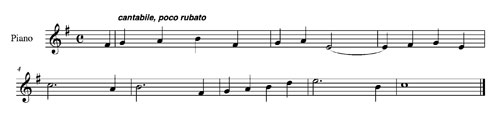
(You can click on it to hear it.)