A little bit here, a little bit there (Day 331/365)

Let’s see, I finished the additional material for the Big Ideas column, outlining exactly what GHP is like:

What is it we do here? In the past three weeks, I have seen classes in multicultural eschatology, cultural violence and Titus Andronicus, and “fuzzy billiard ball” math. I have heard concerts which included a full symphony orchestra, string quartets, 20th century songs using 14th century Dutch texts, and percussion kids banging out Rossini on tin cans.

I have watched seminars on Casablanca, “Life at Yale,” and how to waltz. I’ve seen theatre majors working on Anne Bogart’s Viewpoints and comedy improv. I’ve watched dance majors switch from ballet to hiphop in a heartbeat. I’ve listened to agscience majors describe how to palpate a cow and debate carbon neutrality as it affects agribusiness.

I’ve watched our students meet and bond and talk and laugh. I’ve watched them pack an auditorium to hear their new friends play chamber music. I’ve watched them crowd the circle between the dorms and dance their Saturday night away. I’ve watched them play soccer on the campus lawn, challenge each other at the math tournament, and perform “American Idol” in Latin. I’ve seen them as they slowly have become GHP.

I threw some ideas on paper for a third verse of “Love Song.” No real work on that, though. I still have to work on the melodic issues, plus come up with the bridge section of the song.

I got through another half of a lesson in Logic, learning to import audio files, MIDI tracks, etc. (Helpful hint: drag and drop.)

I found five more old MIDI exports of the Stars on Snow album material and imported two of them into Logic. I didn’t do anything with them other than to give them a quick listen to see if they were still worthy of my blockbuster new age album.

And then there is “Dance for Double Bass Duo.” I opened a Finale file yesterday and began playing with the idea of creating a piece for these unfortunate, lumbering instruments that won’t have the audience stifling giggles. The problem is multifold: the upper range is thin and powerless and hard to keep in tune; the lower range is impossibly low, more felt than heard, and melody is impossible. There’s a very narrow range in the middle where you can play a melody that is hearable and bearable. The strings are very thick, so they’re very sluggish, i.e., no quick runs and skipping about; because the strings are very long, getting from one note to the next (accurately) is a matter of a long reach, so again, no quick runs or skipping about. Double-stopping (playing two strings at once) is just about out.

As you can imagine, there is not a great amount of literature for these instruments to play solo, so what we’re usually subjected to is transcriptions of cello pieces or worse. This never works, taking a piece written for the most lyrical of instruments, the cello, and asking the poor behemoths to sing and dance to them.

So my intentions are noble, trying to write something that will accentuate the double bass’s strengths and avoid its weaknesses. The problem is that this is not at all easy to do.

However, today I gave up trying to actually write a piece and just started playing with melodic and rhythmic fragments, trying them out and hearing what the computer made of them. Fortunately, the GPO versions are very truthful, so I feel as if I’m getting a good idea of what works and what doesn’t. My intentions are to return to the piece tomorrow morning and really work on it, perhaps just forcing it out and surprising Stephen with it on Monday.
Stars on snow (Day 329/365)

Okay, see, I told myself I wasn’t going to do this, I wasn’t going to play with Logic Express, I was just going to slog through the lessons in the book.

But I played.

Years and years ago, like ten or fifteen, I amused myself writing a couple of little new age-y pieces in a halfhearted attempt to come up with enough for an album. My model was Ray Lynch’s Celestial Breakfast, a perky little chart-topper from 1986. I thought, hey, I have a gift for cute melodies that stick in your head, and I can certainly noodle around with heavily-reverbed synthesizer sounds in a lazy, tonal idiom, so why not give it a shot?

My first effort is still one of my favorite pieces. It’s called “Stars on Snow,” and I decided that would be the title of the CD as well. (I even had an album cover designed at one point.)

Anyway, this was back on my little black Mac notebook, a PowerBook 190 I think it was, running OS 7.x. My sequencer of choice was EZ•Vision by Opcode, a wonderful and simple little program that I really miss some days.

Anyway, EZ•Vision stopped functioning when we hit Mac OS 8; Opcode went out of business, and that was a dead end. I had the good sense to export many of my pieces as MIDI files, so I could import them into my newer programs, like Finale or Intuem (which I bought because of its resemblance to EZ•Vision, at least in its earlier incarnations).

Last night, I imported the MIDI file of “Stars on Snow” into Logic Express and used my newfound prowess to assign some new age instruments to it, and then I was addicted. I changed the bass instrument four times. I explored different bell sounds for the upper voice. Where was that string pad I knew had to be lurking on at least one of the synths?

And then there was the tweaking: all those little “Channel Strip Settings” can actually smooth out a sound, add a reverb, drop it an octave. And before that, even, in the synth itself, you can spend hours making each and every instrument change. It was fun.

So add another project to the summer, along with Day in the Moonlight (which I promise I will continue to work on, Mike, you selfish bastard): the return of the Stars on Snow album.

It’s not finished yet, because I have a lot of tweaking of the original MIDI data to do, but I present to you the first track of Stars on Snow: “Stars on Snow.”

More Logic (Day 328/365)

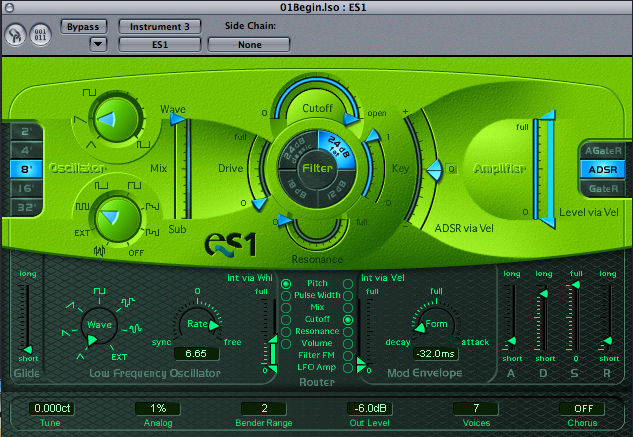
See, y’all thought I was kidding. Check this out:

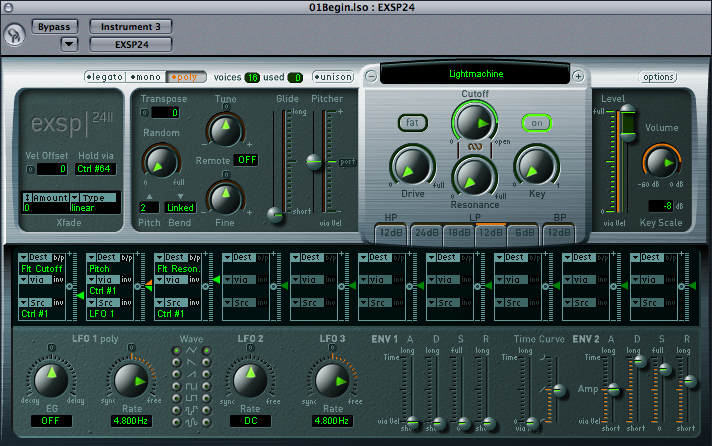
…or how about this:

These are two of the synthesizers available to me inside Logic. Oddly enough, I know what the ADSR thingies are (see if you can even find them) from my days of playing with my Ensoniq keyboard: Attack, Decay, Sustain, and Release. I used them on the Ensoniq to modify and save my own string sounds, since until quite recently electronic musicians apparently thought string sections were for playing lush, quiet, slowly building “pads.” Trying to get one of their string sounds to play a quick run, or a sharply attacked chord, produced only sad little gulps and wheezes.

Of course, I don’t have to build all my instruments from scratch, and for my eventual purposes with this software, I doubt I’ll ever need even to modify them. I can just select one of the hundreds of voices/patches/instruments/whatever they’re calling them these days and go with it.

I’ve struggled through half another lesson in my Logic book, but at this point I’m not sure exactly what I’m learning. I seem to be looking at all the available windows for editing the “audio regions” and “MIDI regions” and all that stuff. I think the book is assuring me that we’ll dig in and learn exactly what they’re all for later in the book. I think.

Of course, even though learning this software is one of my goals this summer, I recognize that what I’m really doing is avoiding producing sucky music and lyrics for Day in the Moonlight. I hate this part of the process, even though I know it’s inevitable: you just have to produce the crap and get it over with.

But I hate producing crap. I hate it, hate it, hate it.

37 more days to go.

Logic (Day 327/365)

Before I start: Happy Birthday to two of my favorite people in the world: Grayson Lyles and… Nancy Willard. Is that strange or what? Even stranger, it was just last night that I learned Nancy shared a birthday with my son. As a birthday present to her, since I learned this on Wikipedia, I edited the “stub article” for A Visit to William Blake’s Inn. It is no longer a stub. Go check it out.

One of my creative goals for the summer, you will recall, was to learn the software program Logic Express, which I bought with my new MacBook Pro back in January. Today I started doing that.

You may also recall that I had opened it earlier in the spring, thinking it might have some solutions to the William Blake’s Inn sound issues, but closed it nearly immediately because it was not exactly an intuitive piece of software. It was my worst nightmare, a piece of software that you cannot use without reading the manual.

So I bought a manual: Logic Pro and Logic Express 7: professional music creation and audio production, by Martin Sitter. It’s very clear, and I forced myself today to sit down and start at the very beginning and go through step by step, not skipping anything.

And I nearly gave up again. It’s all jargon: “arrange window channel strip,” “object parameter box,” “transport panel,” “region paramenter box,” “audio region,” ” MIDI region,” “arrange area”… and that’s just in one window.

Still, I persevered. We learned how to select tools (but not what they’re for at the moment), controlling playback (although the 0 on my keypad does not make the song stop playing as the manuals suggests it should), and the myriad ways to move the Song Position Line (the playback cursor) from one point to the next.

I learned (in the tutorial song file) to change an instrument’s sound using plug-ins (although the one in the tutorial produced no discernible difference in the little pop piece they’d set up for me.) The idea that I could deliberately control the sound I wanted by knowing which of the controls in the Slow Panning Chorus setting of the Modulation Delay plug-in to move (quick, pick one: Feedback, Width (???), LFO 1, LFO 2, LFO Mix, Vol. Mod., Anti Pitch, Constant Mod., Flanger-Chorus, Stereo Phase, or Mix), that I could deliberately manipulate all those controls on one plug-in (out of maybe fifty?) and know what I was doing, is laughable.

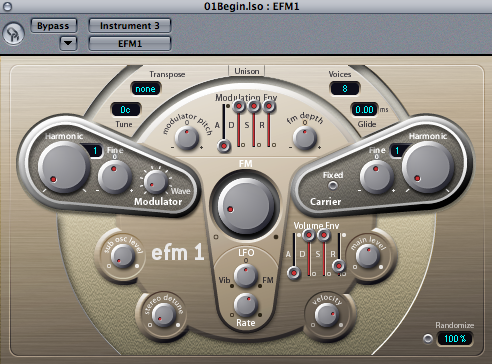
And then I learned how to create a new track and assign an Audio Instrument to it. When I was instructed to select the EFM synthesizer, and a space age thing popped up,

, I freaked. I had to walk away from the computer.

But when I came back, the lesson continued with that little triangle button under the Bypass button at the top of this thing. Down popped a list of instruments. Fabu instruments for all kinds of space music, europop, trance music, rocking out, all that good stuff.

At that point the book had the good sense to say, “Go explore.” So I began to look through all the sounds in all the synths that are residing on my computer inside the software, and Lo, it is good. This is going to be fun. All my Garritan Personal Orchestra sounds are there, via our old friend Kontakt Player 2, plus all these other new sounds, easily mixable. So what if Finale can’t mix the old vocal sounds with the GPO orchestra? Logic Express can.

I ran out of time at this stage of the game. Tomorrow I will have to get back to work on Using Channel Strip Settings. Let’s see if I can remember any of what I read today.

…and so forth (Day 322/365)

So today I wrote a second verse to “Love Song.” I’m still not sure about it.

I’m also still not sure about the melody at all, especially after hearing the GHP music majors in their Prism I concert play a couple of Piazzola tangos. I may have to steal some of his ideas. I’ve written a more sinuous melody line, actually a very nice tango, but I think the comedy might be served better by a more straightforward vocal line.

Stephen Czarkowski handed out the parts to Milky Way today and said that the players blanched. He seemed delighted. He also encouraged them to ask me questions about their parts. Great: now I get to have my ignorance exposed by gifted 17-year-old musicians.

Anyway, here’s the second verse to the tango:

There’s always been a something about you
(a small equator)
No one else I’ve ever met would do for me
(I must get out more)
I can’t imagine life without you
(I can do that later) or (It might be greater.)
How dare you die and set me free?
(This means war!)

I know, I know. I have some polishing to do.

Another little bit (Day 320/365)

I wrestled a melody out of the rest of the first verse of “The Love Song of Thurgood J. Proudbottom.” I also finished that one line that used to go And… something something something. Now it’s And in my dreams you float above me.

The accompaniment/harmony is only sketched out. Yes, I know, if I were a real composer, it would already be there. I’m exploring new territory here, the musical show tune, and its harmonies are unfamiliar to me. No, I’m not kidding. Remember that I have no formal theory training; I have to intuit what I’m doing.

45 days to go.

A little bit (Day 319/365)

A little bit here and a little bit there.

During the morning, I taught the minuet to the string players and had a nice chat with them about why knowing this kind of thing should inform their playing. (I also dropped off the parts for Milky Way at the same time.)

In my afternoon break time, I pulled up the tango and looked over what I did yesterday. Not bad, although of course the computer cannot play the recitative in any way but straight time, so that will rely on the interpreter. I added accompaniment to the first phrase, and it was very nice.

Here’s my problem: it seems too easy. The melody for the thing just plops onto the page, which makes me suspicious. Have I already heard this somewhere? Is this somebody else’s melody that has wormed its way out of my subconscious? The accompaniment certainly does not seem familiar, but the melody flows like an old friend.

Either I’ve gotten very good at this, or I’m a plagiarist.

General productivity (Day 318/365)

I was quite productive today.

I printed the score and the parts for Blake Leads a Walk on the Milky Way for the GHP orchestra and chorus to look over in a couple of weeks. Actually, I printed the parts three or four times. The first time, the page setup was set for tabloid size paper, and it took me a while to figure out why I couldn’t get all those parts to print on regular paper.

Then, of course after they printed, I saw corrections I needed to make: add the part name (e.g., “Flute” or “Trumpet 1”) after the title and page number on second pages and beyond. Otherwise, of course, if the sheets got shuffled, one could not tell which page went to which part without a lot of time-consuming double-checking against the score.

Then I noticed that the combined percussion parts didn’t label the staves with the appropriate instrument, and then I realized the parts would be cleaner to read if I had Finale drop the empty staves out of the picture.

None of this sounds creative in the least, and it’s not really, but it’s donkey work in service of the overall creative effort.

However, I did actually create today as well. I pulled up the lyrics I’d dashed off last week to “The Love Song of Thurgood J. Proudbottom” and began to work on that song.

I extended the intro:

Thurgood:
My love for you is like a… what?
Alexandra:
A rose?
Thurgood:
I suppose…
Alexandra:
Or what?
Thurgood:
More often than not,
I think of you,
though my eyes are usually bleary and bloodshot,
a whole lot,
as my terminally delicious and suspiciously over-ripened
kumquat.
Now let’s gavotte.
Alexandra:
But this is a tango!
Thurgood:
Then make it a mango.

I’m especially proud of the last two lines. Then I set it and the first four lines of the verse to music. Then it was time to go to the Wind Ensemble Concert, and I had to stop for the day.

In other news, I taught the waltz to about 200 kids tonight in the first of the GHP Period Dance seminars. About half left halfway, it’s really too many people, but those who stayed had a great time. It’s always amusing how little these boys understand about dancing with a partner, and vice versa!

At any rate, we made it through the waltz, the polka, and the galop. Next week: English country dances!