Phoenix, 2/23/10

I have set myself the task of composing an a cappella SATB piece by Saturday in order to enter into a competition the deadline of which is Monday. That means I have to have it finished by Saturday so I can polish it by Sunday and pop it in the post first thing Monday morning to have it postmarked March 1.

(I’m also submitting the SATB arrangement of “Sonnet 18” to the Yale Glee Club Emerging Composers Competition , that goes in the mail tomorrow.)

Anyway, I asked my fellow Lichtenbergians to suggest a text yesterday. Lots of good responses from them, of course. I really really liked Mike’s suggestion of Edward Lear, and was set to compose “The Dong with the Luminous Nose” or “The Jumblies.” Ironically, in searching my hard drive for the text to “The Jumblies,” I came across a list I had started back in 2008 of my Lichtenbergian goals, and for 2008, one of them was to set “The Jumblies.”

I began thinking of textures for “The Dong” and had given quite a bit of thought to it, using the voices as orchestral accompaniment along with the text, but I think it’s too long. The piece has to be 4—8 minutes long, and I was having to cut sections before I even began. I wasn’t sure I could get it all done by Saturday. It’s not strophic; Lear wallows in the verse without regard to regularity, so I wouldn’t be able to cheat by repeating verses like I did with “Blake Tells the Tiger the Tale of the Tailor.”

Fortunately, one of Marc’s texts was equally tempting, and a great deal shorter if, naturally, a lot more opaque:

I don’t want to be a phoenix.
I want to be something learning to walk
Like the corpse at a funereal dance.
I want to learn the rainbow’s backstroke.
I want release from restraint.

What to do?

The sky scares me.
Graceless hands reach out of the clouds.
Are these those clouds of unknowing
The books talked about?
Am I crossing into wonder?

What to do?

I feel so helpless.
All the familiar doctors
Touching the familiar folds
And I quake in the same cold ways.

Am I made of water? Why?

What to do, indeed?

Here’s my first stab, score [pdf] and sound [mp3]. It’s only the first phrase. I’m thinking of marking the opening wail Keening, because that’s what Marc would do.

At the moment, I have a vague plan. The first stanza will be fairly knotted, as you’ve heard, with a little loosening at “I want release…” but knotting back up with “What to do?” The second stanza will, despite itself, begin to cross into wonder. The second “What to do?” will be unable maintain its confident despair. The last stanza will be almost resigned to its loss of nihilism. I’m almost certain that’s not what Marc intended.

Thinking in a cappella is very hard for me.
Composition competitions, redux

I got the American Composers Forum newsletter yesterday and there on the front page was an article by Eric Whitacre, “Advice for the Emerging Composer: Competitions.”

Eric Whitacre, for those who do not know, is one of the major cool kids of contemporary choral music. His blog is here. Highly readable.

Anyway, he outlines some benefits for emerging composers to enter all these competitions. The first is exposure, which makes sense. Even if you don’t win, the judges will have seen your work. He says several times judges have contacted him to see if they could program his work that didn’t win the competition.

Second, he says, you’ll finish the piece. I’m a Lichtenbergian. ‘Nuff said.

Third, and I will quote him directly here:

In the last 18 years I’ve probably entered a hundred competitions and I have never won anything. Nothing. I lost the ASCAP Young Composers award three times (in three different years I entered “When David Heard,” “Lux Aurumque,” and “Cloudburst,” lost with all three.

And more of the same. Incredible. “Lux Aurumque,” sung here at a midnight mass in London. Didn’t win. His most recent post talks about getting a letter from the American Academy of Arts and Letters, rejecting his application for an award they had invited him to apply for.

He says not winning is a good thing. It helps make you stronger, if you’re smart, because it reinforces your sense of your own worth. Your piece should have won, dammit, because it was good, and you know that. It’s what keeps you writing more.

All in all, a timely and enjoyable article. And now I have yet another blog to keep up with.

AFO sketches, 2/12/10

Yes, I said “sketches.”

First of all, I took Marc Honea’s “Vibes” piece, which I will let him explain in comments, and which sounds like this [mp3]. He sent me a MIDI version of that, which I sucked up into Finale 2010, creating a score, after much mucking about, that looks this [pdf].

My only goal today was to slam some of those notes into a Finale file that would start playing with the orchestration to see if would even work as a string piece. My suspicion is that it’s always going to sound better and cooler in the computer version. However, here’s where I’m stopping for the day: vibes sketch 2/12/10 [mp3]. Four measures of bass vamping, then the first four measures minus the top notes, then the same four measures with the top notes added back in.

I couldn’t resist the glockenspiel.

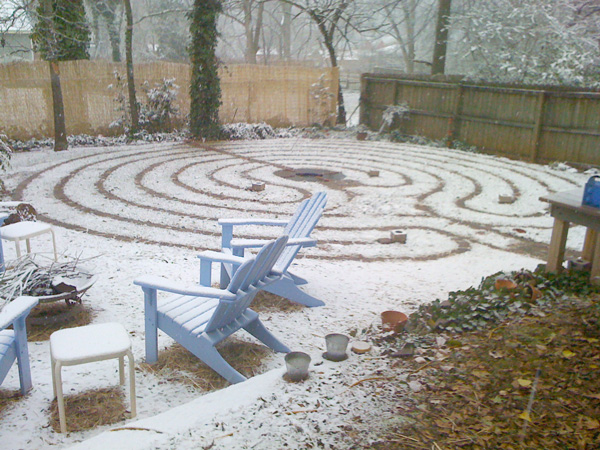
About this time, as I took a break for coffee, it started to snow. I went out on the back deck and watched it begin to come down. Why not a piece called “The Labyrinth in Snow”?

Here’s what I’ve plopped down. It’s got some nice bits, but it’s still just noodling. Labyrinth sketch 2/12/10 [mp3]. The violin accompaniment will continue under the cello solo, probably quiet little triplets. In addition to the piano, there will be a solo violin as well. The three soloists will wind in and out over increasing flurries from the rest of the strings. I think.

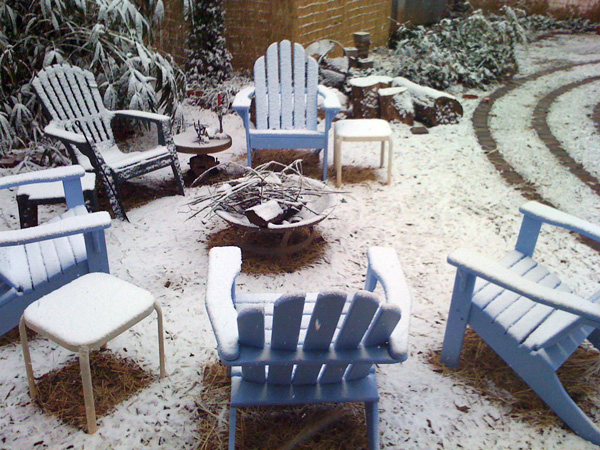
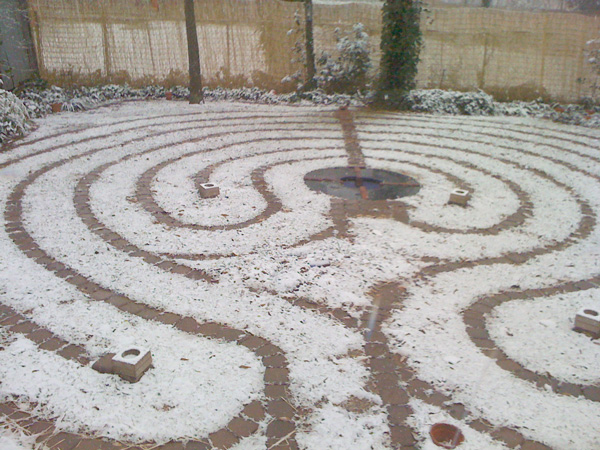
And just so you can share in it, here’s the labyrinth. In snow.

Update, 5:14 pm:

Here’s the most recent version, a little extended. I’m thinking about changing the opening to be a lighter, more mysterious, trill-y kind of thing. Labyrinth 2/12.b [mp3]

Composition competitions, part 2

I went through all the forms and rules and regs last night to match up deadlines and what I might have on hand already to submit to each one.

I had to ditch the Utah Arts Festival right off the bat. They expected a recording of the work you’re submitting as an example of your work, no MIDI realizations permitted. In other words, you either have had performances of your work already or you have access to musicians. Oh well.

The Yale Glee Club, deadline March 1, is getting “Sonnet 18.” (They have a prize of $1500 + travel expenses to the premiere.)

The Meistersingers (Huntington Beach, CA) needs an a cappella piece. I’ll have to write one, and since it’s due March 1, I bet this one doesn’t get done. ($1000 prize, plus performances and recording.)

The University of Illinois School of Music has the Salvatore Martirano Memorial Composition Award, $1000 first place. They’re going to get the quartet/bassoon piece I did last summer. Since their deadline is not until March 15, I’m going to try to write two more movements for that. Maybe.

The Composers Conference and Chamber Music Center at Wellesley College (Wayland, MA) is also getting the quartet/bassoon piece, also due March 15. This one is an actual conference you get to attend and work with older/wiser composers and hear your work worked on. Or something. The call for scores is pretty fuzzy. It looks as if they’re asking for scores of anything you’ve written for judging purposes, and then they’ll pick ten people to come play at this conference. So they may also get “Milky Way” and the “Epilogue,” because those are pretty.

The 1st International Chorale Composition Competition, from the Monteverdi Choral (Cles, Trento, Italy) wants either a setting of “The 33rd Song” from the Divine Comedy for SSATBB chorus, a cappella, or a children’s choir piece, also a cappella, any text. (Prize is $1000 + publication.) Since the Dante is 39 lines of Italian, I’m not going there. Anyone want to write me a text for the children’s piece? Deadline is not until March 31.

The New York Virtuoso Singers want either a cappella or piano accompaniment. Deadline is April 10. They’ll get whatever I write for Meistersingers, which means they may get nothing. Prizes include nominal sums + performance in NYC + possible publication by Schirmer.

And finally, the National Opera Association’s Chamber Opera thing, deadline May 1. They’re getting William Blake’s Inn, and it’s up to them to decide it’s not an opera. Of course, if they decide it is, then I have to rescore the whole damned thing for 20 players. Somehow I am little concerned about that.

Fanfares? If I get inspired by all the rest of this, I might knock one out.

All righty, off to work on none of the above: I’m going to try fiddling with Marc’s Vibes piece.

Composition competitions

The American Composers Forum website is broken, apparently, so rather than having all the opportunities just listed on the site, they sent out the entire list via email, which is what they used to do.

Since my flameout with the symphony, I haven’t really bothered looking at all the various competitions and calls for scores that flooded my inbox every month. Since I wasn’t writing anything, what was the point? Now, however, the AFO commission has gotten me moving, albeit slugglishly, so I printed out the list.

First of all, what’s this obsession with younger composers? About a third of the competitions were for composers under the age of 30 or 40. Screw them. I like the Yale Glee Club approach: “Composers should be in the early stages of their musical careers.” That’s me, right? I’ve had nothing published and precious little performed. If I’m not emerging, I don’t know the meaning of the word.

These are all opportunities with deadlines in the next six weeks, so I’m going to be submitting stuff I’ve already written for the most part. Just this morning I arranged my Sonnet 18, originally for men’s chorus, and on YouTube here, for full SATB. That should fit the bill for most competitions: unpublished, and unperformed in this arrangement.

But I’m also looking at several orchestral/chamber opportunities. I don’t know exactly what I’ll do for those. There’s always the orchestral arrangement of “Milky Way” that I did for last summer’s abortive Chinese event, but that wouldn’t be small enough for a chamber competition. I haven’t examined all of those carefully yet, so I may have to chuck some of them.

There’s the National Opera Association’s chamber opera competition, and for that I think I’m going to submit William Blake’s Inn. Why not? What’s the worst they can do to me? Blackball me?

There are two wind ensembles who are both celebrating their anniversaries with a call for fanfares. That could be a lot of fun to work on, although I’m not very comfortable with the band sound.

At any rate, that’s where I am, compositionally-speaking-wise, at the moment.

New music

And we’re off. This morning I heard from Wallace Galbraith, and here are the answers to my questions:

  • around 70 players – 56 violins, 6 cellos, 2 basses, 1 accordion, 3 guitars, 1 percussionist and 1 pipe
  • 4-5 minutes
  • “it would be interesting and challenging for us to play music with its roots in your part of the world – please feel totally free to let your imagination roam!” [Uh-oh. Do we need to discuss this?]
  • “a deadline – it would be useful to be able to start work before Easter 2011 so let’s say the beginning of March”

Let the agony begin.

New music?

The Ayrshire Fiddle Orchestra, which has visited Newnan from our sister city of Ayr before (2005), will return to these shores in the summer of 2011. I have been asked to write a piece for them.

We’ll see.

Of course I want to, and I’ve agreed to the project, without question, having emailed their founder Wallace Galbraith this afternoon to introduce myself and get the ball rolling.

But we all know what happens when someone makes plans to perform a work of mine. Inexplicable complications ensue, up to and including sudden, unexpected retirement and H1N1 epidemics in China.

However, we shall proceed as if no such omens from the universe were expected.

So, what shall we write? You can hear the orchestra on their downloads page: very competent, sprightly interpretations of mostly Celtic dance pieces. They don’t list violas as part of their instrumentation, and the photos are too small to see. I see an accordion in their large group, and I hear a drumset on the mp3s, but the first question I asked of Wallace was what instrumentation would be coming next summer.

I also asked about length. I’m guessing we’re not in the market for anything as long as “Blake Leads a Walk on the Milky Way.”

Finally, I asked about character: would they prefer something closer to their usual repertoire, or would they like to show off in a different direction?

My goal is to write three to five sketches based on Wallace’s response and let him pick the one he’d like to see finished.

Oh, and I asked for a deadline. Of course.

Listening experiment

Not really an experiment so much as a controlled experience. I noticed, or thought I noticed, that iTunes was focusing on certain CDs to the exclusion of others. So I created a smart playlist for classical/orchestral music which excluded anything that had been played since June 1 of this past year.

I was right. There were a couple thousand tracks, some of which I had not heard since 2007 or even earlier.

That’s what I’ve been listening to for the past week, and I’ve got three and a half days of solid music still to go.

At the moment, I’m hearing Bach’s Keyboard Concerto #2 (Murray Perahia on the pianoforte) as if for the first time. It’s gorgeous, of course.

In a scan of the contents of this playlist, I notice that iTunes tends to shun the first CD of any 2-CD opera set. I’ve been hearing the ends of operas, but not their beginnings. Actually, I haven’t been hearing most opera, and some other thorny 20th-century stuff, at all, since at school I had been listening to a “culled” classical playlist that excluded stuff that I thought might drive other people crazy. But since my clerk’s been abolished, I listen to whatever I damned well please, and everyone else can just catch up.

As Charles Ives once said, as he beat a concertgoer over the head with his program, for protesting the “modern” music being played, “Stop being such a God-damned sissy! Why can’t you stand up before fine strong music like this and use your ears like a man?” (The music in question was that of Carl Ruggles, which is still tough going even today.)

Lichtenbergian Goal #3

Lichtenbergian Goal #3: compose one complete work

I’ll take anything. Really.

By “complete work,” I am talking about something serious, not just an SATB piece, but something that you could apply an opus number to: the symphony; the trio for piano, trombone, and saxophone; the bassoon/string quintet; or something new that I don’t even have any inspiration for yet.

This is one of my stretch goals, although it shouldn’t be. This is how far removed I’ve become from my own compositional process: I have to stretch just to get something written.

As usual, I will be writing without any hope of performance, although the requestor of the trio I think would play it. The symphony? Who? The quintet? The Waltz movement was supposed to be under consideration for this fall, but that didn’t go anywhere, and there’s no evidence that two or three more movements would increase its chances.

However, it doesn’t matter, of course. I shall be happy to get back into the struggle, eventually.

And of course I will have the opportunity this summer to explore the hypothesis that my major stumbling block is the lack of time (as opposed to the lack of talent). Yes, I have some major landscaping to do in the back yard, but on the whole my plan is to make time to compose in a serious way.

It will be an interesting summer. Discipline or death!

Lichtenbergian Goal #2

Lichtenbergian Goal #2: restart the 24-Hour Challenge.

The 24-Hour Challenge was my solution to the psychological/artistic impasse I found myself in after I abandoned the Symphony. For a long time I was unable to write anything, and the Challenge allowed me to get back into the groove without the pressure of having to write anything that had to be completed. Or even any good.

Essentially I used my readers as a randomizer: you emailed me three numbers, which I used to find a line of poetry in one of five books I had selected for the purpose. Once I posted a selection on the blog, I had till midnight of the following day to set the line(s) to music for baritone voice and piano or string quartet.

The complete rules can be found here. Do not send me numbers. I’m not ready for them yet.

As a project, it was really successful. I was able to spit out eleven fragments of varying quality. Some were really good, others not so much. It didn’t matter. What mattered was that I was churning out notes and learning more every time I did it.

Creativity being the bitch that it is, of course I was able to see putting some of the fragments to use. In fact, part of the therapy of the thing was that every time I felt the tug to complete one of these shards, I could quite honestly tell myself to stop it. Abandon it. Get it up on the blog and move on.

Still, I was able to take one of my favorites and turn it into this summer’s Waltz for string quartet and bassoon. So the project was not only cathartic, but productive.

I missed it when I had to stop because of the pressures of GHP, but somehow I never found the time or focus to pick it back up, despite the fact that I have three sticky notes that have been stuck to the bottom of my monitor since May, waiting for me to put them out there.

Now I want to force myself to get back to work. I still don’t have any real pieces in my head battling to get out, so I might as well go back to churning out the trivial little fragments. It kept me busy, and it kept me exploring styles, harmonies, compositional strategies. I found myself getting bolder and bolder in what I would try, because it didn’t matter. It was my own private composition class.

Finally, I think it delighted people to see what I would do with “their” fragment. There was always an audience of at least one for these bagatelles, and that’s got to count for something! So as soon as next week, perhaps, look for the series to continue with #11, a verse from a snarky poem by Horace, from Mike Mathis.

Then, and only then, can you start bombarding me with new sets of numbers. Thank you.