So…

So we finished singing Song of Wisdom from “Old Turtle” at Lincoln Center’s Avery Fisher Hall and went to the nice dinner reception down the avenue. Good food, open bar, and finally I decided I would go speak to Dr. Tim Seelig, our phenomenal conductor.

He was talking with Rachel Gordon, choral conductor of Northgate High School and one of the soloists of the evening. I slid in and bragged that Rachel was my Susanna in Figaro, and we both said at the same time, “… nearly 10 years ago!” Good times.

Before I could bring up my next topic, however, Tim said, “And how are you doing? How’s that piece of yours?”

Oh. My. He remembered talking to me about William Blake’s Inn when he was in Newnan.

So I plunged right in and asked if I had ever sent him “Blake Leads a Walk on the Milky Way,” because I honestly could not remember if I had. He thought not, because he always responds to those kinds of things.

May I, then? Certainly, he enthused. He’d love to take a look it.

Oh. My.

I figure I’ll give him a week to settle back in with his grandchild, then send it to him. If nothing else, I’ll get an unbiased assessment of its weaknesses.

I am relieved

Today’s email from Composer’s Datebook discusses Bartók’s Violin Concerto, and this passage struck me:

It was only in America, some years later, in 1943, that Bartók first heard his Concerto at a New York Philharmonic concert. He wrote, “I was most happy that there is nothing wrong with the scoring. Nothing needs to be changed, even though orchestral accompaniment of the violin is a very delicate business.”

Wow. This is what jumped out at me: “I was most happy that there is nothing wrong with the scoring.”

He actually was flying blind, not really sure that what he had inked in on the page would work in the concert hall. This is a great relief to me, because heretofore I had assumed that the great composers before this era knew how to write down precisely what they heard in their head, or if they didn’t hear it in their head they at least knew exactly what would produce the sound they wanted.

Not so much, it seems. I’m sure Mozart is the exception, but I’m going to go with a self-serving belief that many composers had to jigger with their pieces after hearing them played for the first time. At least I have a computer which will allow me to hear an approximation of what I’ve written.

Which actually ties in with a post I thought about writing this weekend after attending the Wadsworth concert. After hearing all this magnificent music (and some Chopin) played, I conceived a powerful desire to hear my music played live. I want to hear whether it actually works. Because of ‘the curse,’ of course, I’ve never heard any of my pieces played, but now I really have a hankering.

This puts me in an embarrassing position, because I have no more means now than I ever have had to have my music performed. Someone recently suggested that I pay local artists to play through the cello sonata, for example, but what if it’s too hard? That gets me nowhere, other than to put me back where I started 30 years ago, limiting my writing to the forces I have at hand.

It’s a conundrum.

Quickie

I’m working on a longer post about the memory wormhole opened up by a chance encounter with the title of a play, but the wormhole has turned out to be much deeper than I thought so the post has taken a more involved turn.

In the meantime, I must report that I have not worked on the cello sonata in a week or so. Small crisis of confidence, which is waning but still there.

Yesterday afternoon, during the intermission of the Masterworks concert, a bunch of us were chatting about the piece we’ll be singing at Lincoln Center in June. It’s based on a children’s book that none of us were familiar with. I ruefully commented to one of our William Blake singers that whatever it was, it was not my piece based on a children’s book.

After the concert was over, I got in the van and decided to pull out the William Blake CD and listen to “Blake Leads a Walk on the Milky Way,” the infamous (to the singers) No. 10.

It’s gorgeous, folks, still. This morning, the CD picked up with “When We Get Home, Blake Calls for Fire.” I let it run, and this music still gets to me.

It restored my faith in my ability as a composer. At least of choral music based on children’s works.

Cello sonata, mvt. 2, take 2

I made myself sit down and work on the Adagio for the cello sonata, and I think I may have made some progress. I’m still not completely on track, but I think I have some building blocks.

The building blocks include:

  • an extremely limited dynamic range, from pp to pppp
  • short ascending chromatic fragments
  • a tonal language that is ambiguously tonal/atonal

Another thing I’m playing with is independent cello and piano lines. One bit I’ve gotten down on paper involves the piano playing a steady ostinato while the cello grinds out its chromatic fragments, lagging further and further behind. The problem is that all that has to play out in my head; I can’t notate it in a way that the computer can play accurately. It’s a problem because I’m not a real composer: I rarely hear these things in my head, and I won’t be sure it really works until the players try it, and then they’re 700 miles away.

It’s also a problem because you won’t get to hear the movement in any meaningful way. I’ll eventually put up something, but it won’t be the real thing.

On the whole, though, I think it is promising. What I have written made me feel very, very icky, almost queasy, and that’s actually my goal. That way, the third movement becomes a tremendous release.

At any rate, I’ve emailed Stephen (our cellist) to ask some pertinent questions about my strategies; I’ve not heard back.

Winter break: Day 5

I’m posting this a day late because I was out of town during the evening.

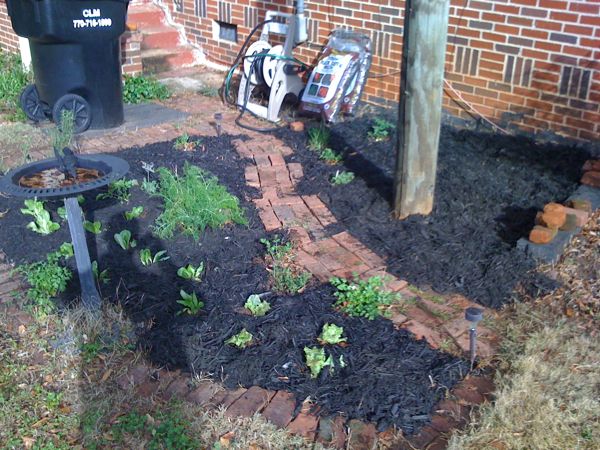
Spent the morning finishing up the herb garden. After the Revolution, I will always buy exactly the correct number of bags of mulch. I will not have to return to the store to buy more, and neither will I have two bags left over after I have done so.

Notice the two bags of leftover mulch.

Survivors from last year: rosemary, dill, parsley, chives, and two or three cilantros. New plants: oregano, sage, thyme; arugula, Romaine, Bibb, and red leaf lettuces. Still to come: basil, tarragon, maybe some mint, and lemon verbena.

I made the mistake last year of not mulching, which meant that I spent four hours tilling the place up and then laboriously pulling the grass out by the roots. Two huge piles of detritus to the curb.

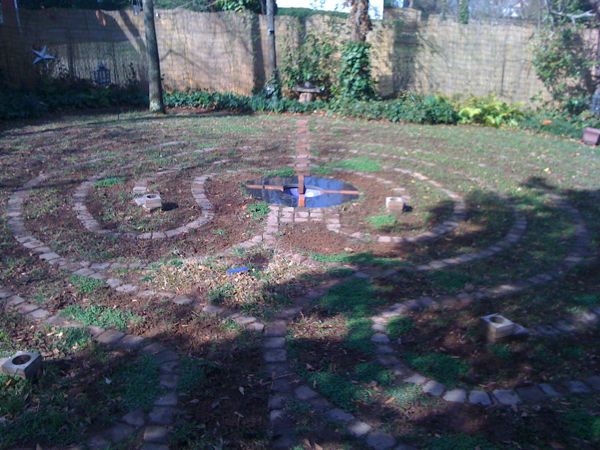
Since it rained the night before, the soil in the labyrinth was soft enough to rake through and scatter seed.

I’m a terrible lawn maintainer. When I say “reseeding,” I mean, “scatter some seed onto the raked, slightly disturbed soil and hope for the best.” I do water it, but you’re supposed to till the soil to a depth of 1 to 2 inches, then scatter the seed and rake it under 1/4 inch. Hello?

At this point, I’m hoping the oxalis takes over. It grows like the weed it is, it’s pretty, and it’s soft underfoot.

I had formed the impression that it was going to rain all day on Friday, so I put off all serious work on the cello sonata until then. Oops.

I have at least formed some opinions. I talked about using the chromatic motive as a building block, but I am also considering a cello solo for the second movement; give the pianist a moment to rest the weary fingers before that third movement. And I think I’ve reached a major decision about the third movement, after doing the obsessive listening thing in the van while running errands this week. Currently, there’s this gorgeous rush of sound that kind of blooms forth, then finally calms down to a halt and a calmer midsection.

It has made sense structurally, in that the first 1:20 there’s no place for the audience to breathe. It seemed to be exhausting, and my instincts were to bring all that rush to a close and to provide a more static interlude before picking up the quintuplets in the piano again.

However, what if I didn’t do that? What if, at the 1:20 mark, I gave the spheres another spin and kept us going through yet another rushing passage, building and building until the whole thing just explodes in ecstasy? I can keep that interlude material for another piece. (Yes, I already have notes on a second cello sonata, including the AFO sketch Labyrinth in Snow.)

Comments?

Winter break: Day 2

After running some errands, I settled down after lunch for some meditation and composing in the labyrinth. The sun once again has cooperated.

Today, I sketched out what I thought would be a pretty woeful theme, only to have it turn out to be a theme already on the books. I think it’s a Schumann symphony. Its exact identity is eluding me, but I know it’s not mine.

I revisited what I sketched out yesterday, and I developed a plan, if not a theme. Yesterday’s work included a tiny chromatic bit, inching upwards through the scale. Very short, and it labored, petering out al niente.

My thought was to use that as a building block, starting from silence and having the cello struggle with it, over and over, back into silence. The piano joins, layered and canonic, and we get a thick texture of these little tortured wormlets, crawling up, dying off.

When that’s satisfactory, I want to have the cello reverse course, sliding inexorably down through the wormlets, until we reach the ending I’ve already written, a crushed morass of chords at the bottom of the piano.

Sounds lovely, eh wot?

Last night at Masterworks practice, Viva Voce went over “Make Our Garden Grow,” from Bernstein’s Candide. I love this piece. For those who don’t know the show, it’s the finale, when Candide and his ladylove Cunegonde end up outside Constantinople (I think; versions differ) and he finally puts his foot down on any more “best of possible worlds” thinking. We will eschew the entanglements of philosophy, he says, and till the good earth. We’ll make our garden grow.

The piece is gorgeous, a full-throated paean to minding your own business and taking care of life. “We’re neither pure nor wise nor good; we’ll do the best we know. We’ll build our house and chop our wood, and make our garden grow.” The suspensions and resolutions at “garden grow” alone are worth the price of admission.

That concert, by the way, is Sunday, March 13, 3:00 pm, at the Centre for Performing and Visual Arts.

The role of Pangloss is one I’d love to play before my voice gets much older, and it seems to be getting older by the minute. (Tautology, I know.)

Winter break: Day 1

I think I’m going to force myself to write every day this week.

Today was the first day of the school system’s winter break. Weather was pleasant, most pleasant in the afternoon, and I took advantage of that, as I will describe in a moment.

This break kind of sneaked up on me. We had the week off in January because of the ice, and there’s been all the excitement of getting the iPads in and getting them up and running, plus other distractions, and I mostly forgot that I was about to have a whole week off with no real responsibilities. At the eleventh hour last week, so to speak, I decided on a couple of tasks I might work on.

One of course is the cello sonata. I have avoided working on it, because I have no real ideas for the second movement. So this week will be dedicated to straining out stuff that’s awful. Like horrific. Like you will never hear it.

Of course there are things to do around the house, so I made a list. On Saturday I raked out the labyrinth and tidied it up for a Lichtenbergian gathering. I need to write about that over on the Lichtenbergian site.

Today I raked the front yard and did some maintenance on the landscaping across the front, clearing out the dead stems and stuff so that the green can burst forth, which it is already beginning to do. I put off truly revamping the herb garden, but I also cut back all the dead stuff and pulled up plants past their prime. And trimmed that rosemary bush! Why is it that the herbs you rarely use grow like weeds?

I finished reading Wolf Hall, which is an amazing, amazing book. It’s a novelization of the career of Thomas Cromwell under Henry VIII, and it’s a dazzler. I cannot recommend it highly enough. It does not cover his entire life, stopping at a significant moment, so perhaps there will be a sequel. I’d be delighted.

I’m also determined this week to meditate more seriously. I went to the labyrinth and sat in the sun and meditated for ten minutes. I was not very successful, too much brainbuzz going on, but it’s a start.

I also decided I would use the labyrinth as a place to focus my thoughts on the cello sonata. I retrieved my music moleskine and walked the labyrinth for about an hour, forcing myself to imagine music and to transcribe it. This is not my usual working method of course. Normally I must have the keyboard and computer in front of me, or I get nothing done.

Today I forced myself to pull the music from inside. I was relatively successful, filling a page in the tiny notebook with sketches that might actually work.

The problem is that I have planned the second movement to be very, very static, without the cantabile of the singing cello, and how do you sing that to yourself as you pace the labyrinth? If your melodic line, such as it is, is merely half-steps or repeated notes, then you have to start thinking about texture, about pauses/silence, about other structural assets you might deploy.

So that was useful. Weather permitting, I shall attempt this strategy all week. I shall try not to input it into the computer until Friday. Let’s see how this works.

And now, off to Masterworks Chorale.
Cello sonata, second mvt., take 1

This is pretty sad: six measures of music, and it sounds nothing like I want the final piece to sound like.

For one thing, the computer cannot duplicate all the myriad voices the cello is capable of. This movement is marked as “dry, coarse,” and I want a kind of raspy, gross quality to the bowing. So you will have to imagine that.

You will also have to imagine that the piece is played almost without a time signature, belabored, halting, grinding. I can’t replicate that either.

With that in mind, here is the current end of the second movement.

I wrote the ending because it has to lead into the stream of the third movement.